Showing posts with label Entertainment. Show all posts

Saturday, 28 October 2017

REVIEW: Stasi Child

How do you find a fresh way to approach the detective novel? David Young's Stasi Child has a decent answer - with the setting, scenario and characters required for a fascinating tale.


After wallowing in a bit of degree nostalgia with Richard J Evans, I was attracted to this book by the fact it was set in 1970s East Germany. I'd been fascinated by the GDR and the Stasi at university and this seemed an intriguing backdrop for a detective story. The central character, Karin Müller, is a police chief tasked with investigating the case of a grisly murder under the prying eyes of the Stasi, the infamous secret police.

Fittingly, there's more than meets the eye about the case and pretty much all of the characters we come across. Young captures the paranoia and corruption of the East German state well and it all serves to keep you guessing. All of the main characters have their own agenda and we see their back stories slowly peeled back, mirroring the progress of the case itself. It's refreshing to see the focus on 'real' people too - this is a Cold War thriller that isn't all about spies.

Through Müller we also see a different at the GDR. She's someone who doesn't yearn to escape to the west - she's sympathetic to the ideals of the socialist state and is appalled by the perceived excesses of the 'other Germany'. This makes her character all the more interesting for me. It's often difficult to understand how people in authoritarian regimes thought - and why they 'go along' with them - Müller helps us to see this. Her outlook doesn't make for a rose-tinted view of the GDR, but it does offer a richer understanding of the way real people acted and thought. Hopefully it will encourage people to delve further into the history of this short-lived but fascinating regime.

It's perhaps no surprise that the book is pretty grim too. I'm not sure anyone has a happy ending - and many characters are forced to make dark choices as events unfold. Just as we think Irma - a child we first find locked up in an institution for 'wayward' children - is going to get a positive future, for example, we learn that the price of her freedom is to spy on her mother for the Stasi. Informing on friends, family and neighbours was a macabre feature of the East German state and her story brings this to the fore powerfully.

We learn much of Irma's journey through first-person chapters which are interspersed throughout the narrative. It's an interesting writing device, and helps to build up the sense of mystery as the case develops.

Perhaps it's a little convenient that Klaus Jäger - the Stasi puppet master pulling the strings for much of the book - just fills in Müller with some of the missing details at the end to bring us up to speed but that's definitely forgivable and does explain away why some of the steps in the investigation feel a little coincidental.

All in all, Young weaves a complex web of intrigue over an atmospheric backdrop with Stasi Child. It's a riveting read and you can't help but be impressed by the quality on offer for this debut novel. Young tackles child abuse, corruption, authoritarianism, sexual abuse and relationships for good measure. He's also produced a set of three-dimensional characters and a detective story with a difference. I'm certainly looking forward to catching up on how he puts all of these puzzle pieces together in the next two Müller stories.

Thursday, 28 September 2017

REVIEW: What Sport Tells Us About Life

Some people have it all don't they? You could surely be forgiven for envying someone with the talent to be a top cricketer. It's a sport that I'm only 'built' to watch but love. I also find myself reading some top class writers and wishing I had their flair and marvel at the talents of skilled broadcasters. But someone who can do all three? Now that's just not fair...


Yet, in Ed Smith, such a person exists. I'd maybe hold it against him if I did enjoy his work so much.

Having appreciated his insight on Test Match Special - and been impressed by his forays into the pages of the New Statesman - this book was an obvious choice. It's a short book, comprised of 15 essays that address thought-provoking topics. These range from 'The age of the amateur has passed. Worse luck', 'What do people see when they watch sport?' and 'Why luck matters - and admitting it matters more'. All perfect fodder for a lunch time work reading club.

There's a lot packed in to a short space and it's a richly rewarding read that manages to remain insightful without ever becoming inaccessible.

It'd be unfair to categorise this as a sports book - as the name suggests, sport is merely the prism through which we consider some fascinating observations about the world around us, including the role chance plays in our lives and cultural identities.

Best of the lot, for me, was the chapter entitled 'Why history matters in sport (and how England won the 2005 Ashes)'. It's hard to do it justice here, but the way Smith sums up the different theories that might be used to explain the 2005 victory over Australia by comparing them to historical approaches ticked every box for a cricket-loving history graduate.

The chapter also contains a beautiful definition of history, with Smith stating: "The past is a treasure trove of information waiting to be ordered analytically into judgements."

Throw in a pleasing reference to Brian Clough and Peter Taylor - I'm a sucker for a Forest mention - and a thought provoking passage on the way any people watch the same action on the field but 'see' something different (something we all ought to reflect on in an adversarial age of Twitter spats) and you're left with a brilliant blend of material.

Perhaps the only problem here is that there isn't more. I could've easily tucked into twice as many chapters. It certainly feels like I landed on an underrated gem with this book, one that wouldn't disappoint if you landed on it too.


Tuesday, 8 August 2017

REVIEW: The Third Reich in History and Memory

Do you ever wish you could go back to the subject you studied at university? Maybe I'm sad, but I often do. I finished my three-year history undergraduate degree 11 years ago, but I still wish I could keep up to date with the latest ideas and interpretations being put forward by historians. A BBC History Magazine subscription scratches the itch to be fair, but I know there's more 'going on' in the world of history that I'm missing.

I quite fancied doing a Masters but journalism called - and I don't regret moving on to something that offered a job at the end of it.

Anyway, it was a sense of 'degree nostalgia' that drew me to my latest book, The Third Reich in History and Memory by Richard J Evans.


My degree actually started with a module looking at the study of history. In essence, we were asked to consider whether the study of history was really possible or worthwhile. I wonder of they still do that in an era of £9,000-plus fees. Would they want those high-paying students to question the value of their course??

Still, it was during this daunting and difficult early module that I stumbled across Richard J Evans' book In Defence of History. As the name suggests, it offered a strong case for the real value of my degree subject of choice. It remains to this day the most inspiring and influential book I've ever had the pleasure of reading.

From then on I knew I could trust Evans to provide a robust analysis of history and this book was the perfect fit for me. A collection of essays, speeches and reviews from recent years, this explores the latest debates and developments in the studies of Nazi Germany. In essence, this filled me in on everything that's happened in the decade since I was last engaged in academic study and had access to journals etc.

The book is a real triumph, flowing surprisingly well given that it's a collection of material that weren't originally intended as one volume. Indeed the 'episodic' nature of the content was ideally suited to our reading club at work - even if the occasional passer by looked a little perplexed by the subject matter for a lunch time read.

I was particularly intrigued by the sections exploring the way in which people have attempted to link 19th Century German foreign policy and the actions of the Nazis - and Evans' views on the extent to which we can say the Nazis led a 'dictatorship by consent'.

I won't attempt to explore any of the arguments here - I doubt I'd do Evans justice - but it's great to read the work of someone at the top of their profession arguing passionately and persuasively based on facts and experience. Evans is sometimes scathing in his reviews but always seems, to me at least, fair even when he's being firm.

This book ended up being much more than just degree nostalgia. It was intellectually stimulating and enlightening at every twist and turn and I'm pleased I picked it up. If you're missing your degree subject at all, I hope you're lucky enough to be able to find a book like this one.

Monday, 17 April 2017

REVIEW: The Man in the High Castle

You sometimes reach a crossroads with a book don't you? A moment when you pause, scratch your chin, gaze out of the window and ponder 'where is this going?' and perhaps even 'is this any good?'.

I had such a moment with Philip K Dick's The Man in the High Castle. It was about 150 pages in but I decided to crack on, read a couple more chapters and see where it took me. Luckily my persistence was rewarded and I came away glad to have picked this unusual book up.


Take a look at any one-line review or short summary of this book and you'll see that it is described as a dystopian 'what it?' work, exploring what would happen in America if the Nazis and their allies had 'won' the Second World War.

While that's strictly true it really isn't the whole story. I'll admit I was wrong-footed by this book and it's probably what led me to question where it was going. Yes, this is set in an America divided into Japanese, German and neutral thirds but we see this world in a more abstract way, through the eyes of a clutch of intriguing characters. The book isn't about what the Nazis and Japanese would do if they were victorious, it's about how real people would react and what they would think. The ways in which day-to-day life is governed underpins it all, but it's in the background. Events in Germany - with a regime change - loom large, but are seen from afar. There's a chilling mention of what has happened in Africa since the war, with the detail left to the worst of your own imagination to fill in. Most tellingly everyone is seemingly pretty much resigned to life 'as it is', with the action taking place a good twenty years after the end of the war. There's a downbeat feel to the defeated Americans which contrasts wildly with the tubthumping 'God Bless America' of the hegemon of the real world.

The most fascinating aspect comes through the 'book within a book' that lies at the heart of The Man in the High Castle - with the fictional characters all intrigued by their own 'what if?' text, widely read across the States and written by an author who examines what would've happened if the Nazis hadn't won.

It's not always easy to identify with the characters written by Philip K Dick but remarkable things happen to some fairly unremarkable people as the book builds to a close - with a dash of espionage and intrigue coming to the boil in the final third. There's a plot to kill Hawthorn Abendsen - the man behind the aforementioned book - and the realisation that the Nazis are planning to oust their Japanese allies and take over the bits of the world they aren't already in control of.

This isn't really like anything else I've read but that's no bad thing. None of the plot threads are neatly sewn up but, strangely, that doesn't matter too much. This is an eerie book, an alternative reality that poses lots of questions and gets you thinking. If you park your preconceptions and accept the slightly odd nature of many of the characters then there's a reward to be had.

I haven't seen the TV adaptation - I've been reluctant to give money to Amazon after it blew hideous sums on those old Top Gear morons - but it would be fascinating to see what's done with the material here. My hunch is that some of the more obvious 'what if?' stuff might have to be shoe horned back in and it'd be interesting to see what impact that has.

Still, this has all whetted my appetite to return to reading a decent history book. So, next up, I'm going to make another diversion away from my 'next five books' and read something by one of my favourite historians, Richard J Evans. I'll let you know what I think...

Wednesday, 1 March 2017

REVIEW: Dent's Modern Tribes

After starting my reading quest with a bit of fun from Alan Partridge, I jumped head long into Countdown word guru Susie Dent's latest book and certainly wasn't disappointed. 

Dent's Modern Tribes: The Secret Languages of Britain is a celebration of the words and phrases shared by groups of people right across the country - from doctors to journalists to teachers and beyond. It's fascinating, funny and - for some who spends all day trying to pick the right words at work - inspirational.


In some respects it would have been easy for this to slip into being a pseudo-dictionary. As much as that would have been fairly interesting, it wouldn't have made for the greatest continuous read and Dent settles neatly on a well-paced structure instead. Each group is introduced with a short-but-sweet exploration of the type of words and language that they use, followed by lists of terms and their definitions.

That certainly all makes this a good bite-size read to dip in and out of and was perfect for our lunch time reading club. There's little chance that you'll get bogged down or bored here, jumping from bird watchers to darts players to undertakers to freemasons, via plenty of places along the way.

I'm continually fascinated by the words and phrases that we use and the stories behind why we use them and where they come from. It's in these stories that the words offer important nuggets of information about the people who use them and this book is riddled with such stories. It's through these words and stories that many old traditions live on - even in this more digital-led era.

As you go through Modern Tribes, it's interesting to note the threads that run throughout many of our 'secret languages'. Sexual innuendo and black humour, in particular, feature at almost every level of society - shaping the slang that we use on a daily basis. Plenty of these are bound to make you chortle (or maybe that says more about me?) and yearn to deploy some of the most fun in your own life. Dent, you feel, revels in revealing the cheekiest words possible.

There's also great fun to be had in spotting the terms that are familiar with you. The section on the language of journalists and publishers certainly made my eyes light up and contained many familiar words that were par for the course in my newsroom days (spike, splash, nibs, kickers, back-of-the-book etc). The sheer breadth of the groups covered means that I'm sure many people will find something to relate to here.

Modern Tribes is, therefore, a window through which we can have a good old nosey at the worlds of all sorts of different people. It's a word based form of people watching - as well as a celebration of our weird and wonderful language - and is great fun as a result.

Tuesday, 21 February 2017

Nomad by Alan Partridge and rediscovering the reading bug

I'm up and running. After a moan in my last blog about struggling to find the time to read, things have picked up on the book front. Luckily, it emerged that my colleagues (Flora and Ellie) were harbouring a similar wish and, as a result, a small work reading club has emerged. Twice-weekly lunchtime reading sessions have helped me pick up the pace and it has encourage me to get away from a screen for a bit (he says, typing at home). I can certainly recommend it to anyone if you're lucky enough to have a decent space and fellow bookworms working with you.

As planned, I kick-started 2017 with Nomad 'by' Alan Partridge, figuring that it'd be best to ease myself in gently with an easy read and a bit of fun.


Luckily it lived up to the billing. Steve Coogan, Neil Gibbons and Rob Gibbons seem to get better and better at writing for Partridge, finding new situations and observations that keep the character fresh, funny and relevant. It probably should be old hat by now, the fact it isn't is a testament to the quality of the writing, whether it's for television, cinema or, here, as a book.

This book plots Alan's not-so-epic journey from Norwich to Dungeness Nuclear Power Station on the Kent coast, a trip his father had once taken for a job interview. The conceit is, in itself, a parody of the walks, road trips, train journeys etc that celebrities regularly perform and gives the whole thing a neat device to thread it all together.

If anything the premise worked better than that of I Partridge, the character's last literary outing. While I enjoyed that one, the autobiographical format meant that large chunks of it had - out of necessity - to retread the steps of old TV episodes with a greatest hits-esque feel. This all felt fresher, with a narrative loose enough to allow us to veer off along the journey and enjoy a few laughs.

The highlight of the book came in one such random aside. A chapter named 'Edmonds' promised much and reading of the apparent feud between the Deal Or No Deal host and Partridge was indeed laugh out loud funny. The word 'wazzock' certainly needs to make a comeback I feel.

The character's views on celebrities in general - from Eamonn Holmes to Ben Fogle and Dan Snow (or 'Snogle' as their said to be known) - offer plenty of enjoyment. You always feel that the authors have had great fun in using Alan to poke fun at certain people.

Nomad veers from the observational - Partridge's take on the mis-named Head & Shoulders was enjoyable - right through to Operation Yewtree. Yes, really. Footnotes are deployed to good comic effect - as is the ongoing quest to 'fill out' the book.

In the end, this was exactly what I needed. A good, fun, quick read to start the ball rolling and an enjoyable way to escape for a while. Next stop Susie Dent...

Tuesday, 24 January 2017

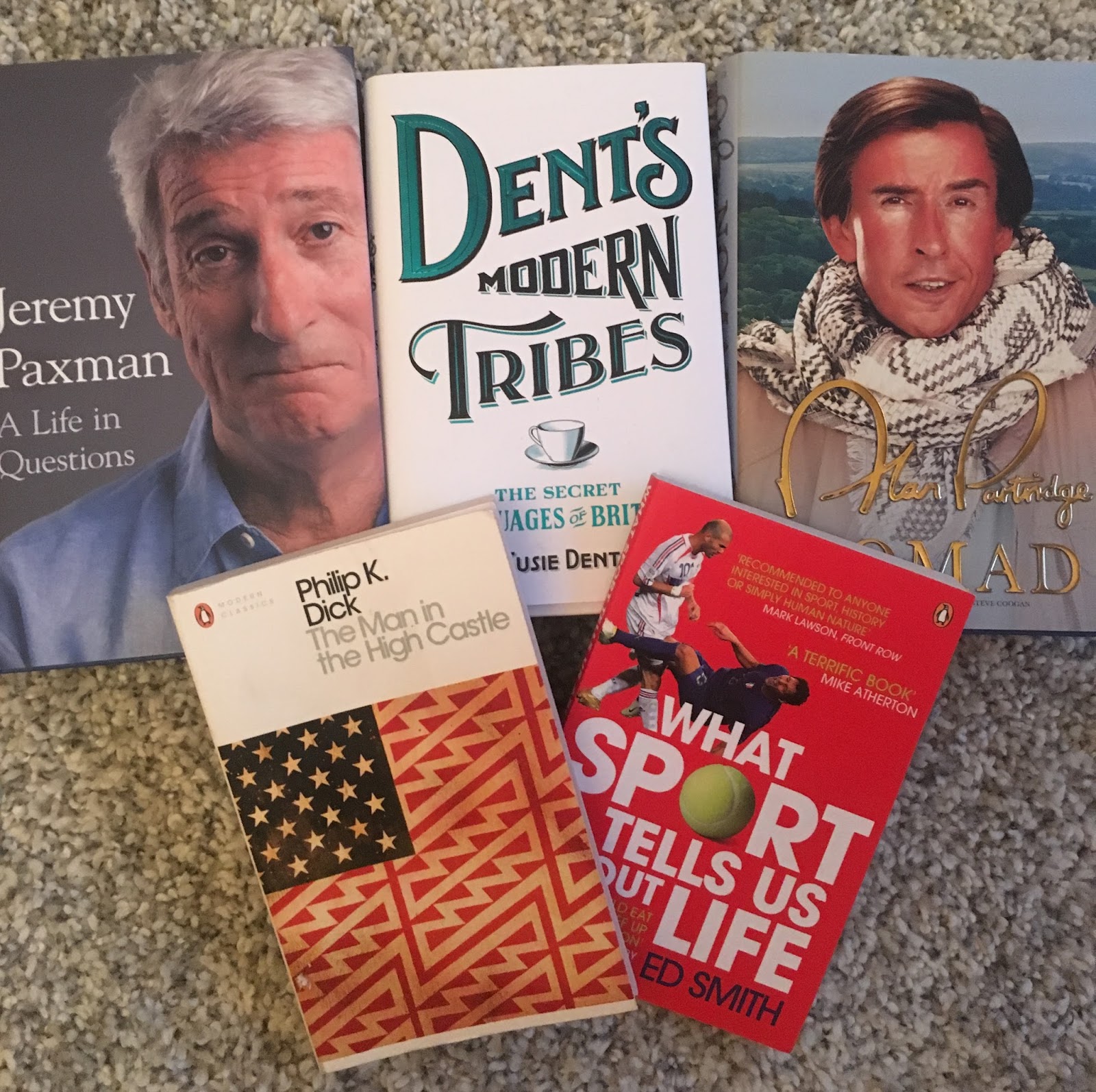
My next five books

I don't really 'do' new year resolutions, which is a good thing really because I'd be pretty late to the party with this blog. It's not just because they're naff and swiftly forgotten - although that's one big reason - but also because I have one rolling/ongoing resolution that stands regardless of what date it happens to be: to read more books.

It's something I'm continually failing to do thanks to a combination of social media (not helped by following the fortunes of a dysfunctional football club) newspapers and magazines, which all eat into valuable reading time. I've often fancied finding a sneaky retreat for 20 minutes at a lunchtime at work but always chickened out.

Still, in the spirit of getting better, I've decided to map out the next five books that I'm going to read in the hope that it spurs me on. I don't usually do this but I'm hoping that having this carrot dangled before me will do the trick. I don't profess to want to fill my time with Booker Prize winners or academic texts (although there's a few history books on the shelf that are giving me a glare), I just want to read something that captures the imagination, whether funny, entertaining or thought-provoking.

Luckily, a combination of a late November birthday and Christmas have left me in a good position, with plenty of fun things that I'm itching to get started with. If your book appears on this list, thanks very much, you obviously know me well.


Nomad, Alan Partridge

I'm an unashamed fan of Alan Partridge and have got high hopes for 'his' latest book. Following on from the autobiography - I, Partridge: We Need To Talk About Alan - Steve Coogan and Rob and Neil Gibbons have penned a spoof travel book following a not-so-epic cross-Britain journey for everyone's favourite North Norfolk Digital DJ. I think the trio have become even better at writing for Alan in recent years and their work never fails to make me smile.

The bag pages plugs alone have had me chuckling and I think this might be the perfect read to lift a gloomy January/February day and a nice one to set the ball rolling.

Dent's Modern Tribes: The Secret Languages of Britain, Susie Dent

I'm fascinated by the way in which we use language and the origins of the words we use. That's probably not very rock n roll I know, but that's me. As a result, I'm often dazzled by the insight of Countdown wordsmith-in-chief Susie Dent (she's worth a follow on Twitter too). Modern Tribes involves Dent looking at the words and terminology only used by distinct groups of people across the UK, including journalists.

A Life In Questions, Jeremy Paxman

I miss Jeremy Paxman. I mean, I know he's still on University Challenge but it's not the same. His Newsnight interviews were superb to watch and put a healthy dollop of pressure and scrutiny on public figures. If his memoirs are half as good as his interviews then they'll be a cracking read.

The Man In The Castle, Philip K Dick

I've heard plenty of good things about both this book and the Amazon Prime TV series it inspired so it's time to see what the fuss is all about. Mind you, it remains to be seen if a dystopian alternative reality in which the 'bad guys' rule America is any different to sticking the news on at the moment.

What Sport Tells Us About Life, Ed Smith

Ed Smith has become one of my favourite voices on BBC's Test Match Special, always describing the unfolding action with a beautifully relaxing and reassuring eloquence. Yet, on top of broadcasting - and a decent cricketing career - he's also a fantastically talented writer (some people eh?). So, when I stumbled upon this little beauty it was too good to miss. It's a collection of 15 essays addressing topics from 'Why there will never be another Bradman' to 'Is the free market ruining sport?' and 'What do people see when they watch sport?'. Right up my street.


So, there we go. I'm pretty pleased with how that's all looking, now it's just time to actually get on with some reading. I'll aim to come back and let you know if they're as good as I hope...

Monday, 26 December 2016

The Crown: A right royal triumph for Netflix

There's a near endless stream of hype surrounding TV these days. So much so that I find it all a bit 'cry wolf'. How can you know which series' really are the 'real deal' and which ones are just pretending to be?

It's perhaps for this reason that I've long lagged behind the modern world and resisted Netflix. I don't watch enough telly to justify getting it. Yet when we recently succumbed and signed up for the streaming service, The Crown was one of the shows on our hitlist. Much had been made of Peter Morgan' expensive royal series and the reviews had been pretty positive. Luckily, it turned out that this was one of the shows that justifies the hype. The first thing to note is the casting and the performances of the key lead roles. Claire Foy is fantastic as The Queen, embracing a role in which she carries the burden of the monarchy on her shoulders in an uncertain world.

We've probably all heard (or even attempted) enough impressions of Her Maj over the years and it'd be easy to have gone with an out-and-out impression of the long-serving monarch. Foy, however, resists this. She captures the right 'voice' and look without straying in caricature. The whole drama rests on the casting, writing and performance of this role - the fact I enjoyed it so much suggests that they got all three aspects just right.

Similar could be said for Matt Smith's Philip. I was surprised to see the former Doctor Who bag this role, but he was able to portray a subtle blend of mischief and frustration that brought the character to life.

In fact, the only role I was disappointed with was John Lithgow's Churchill. If there's one historical character we've seen impressions of more than the Queen then it's Winston and I felt this representation nudged too much toward the stereotype at times. It must've been a hard ask for a New York born actor to handle such a role. It's not awful, it's just noticeably not as good as the rest of the show.

One thing that helps all of the characters is the format of the first series. In 10 episodes, barring flashbacks, we cover the period from Elizabeth and Philip's marriage in 1947 through to the mid 1950s. While there is much ground to cover here, the length of time gives plenty of breathing space for the characters to be fleshed out. There are many dramas and films to have covered this ground before, but it's unlikely that any will have been able to do so with such depth or style.

Speaking of style, it's clear to see that the show's much-vaunted £100 million budget has been put to good use. The episodes are beautifully shot, without exception. The money hasn't gone on flashy effects, it's gone on getting all of the important things right. Looks alone should alert you to the fact that this is something special.

The substance more than matches the style, though. I was also impressed by the way in which writer Peter Morgan knitted the Queen's personal and family drama in with events in the world around her. Churchill political demise, Suez and the smog, intertwine with the abdication, Margaret's relationship and Philip's frustrations. We see how external and internal matters go on to shape the sort of monarch the Queen was to become with lessons on leadership, service and duty laced throughout all ten episodes. We also see a history of Britain through the eyes of the royal family. There's absolutely no need to be a royalist or a history buff to savour this.

None of the characters is a 2D representation of their real-world counterpart. There are things to  admire, respect and understand in most of the protagonists but we're also shown their flaws. I was perhaps only wholly sympathetic with the Queen (goodie two shoes-ness aside) and her father. Philip's petulance, Edward's money-grabbing, Churchill and Eden's politicking, the Queen Mother's scheming and, above all else, the resistance of those in the royal household to change all made for an array of actors who, for various reasons, made life complicated for the young monarch.

All in all, The Crown is a big triumph for Netflix. You feel there will be a bucket load of awards heading its way and you wouldn't begrudge that either. Roll on series two.

Tuesday, 30 August 2016

David Copperfield: A delightful Dickens classic

Has anyone else got a book that has been sitting on the shelf looking at them for a long while? In truth I've got several. But chief on the waiting list was David Copperfield. Until now.


A fair few years ago (7 or 8 I think) now I worked my way through the Pickwick Papers (having previously read Hard Times, Oliver Twist and bits of Great Expectations) and loved it. I know it's not seen as one of Dickens' best but I found it funny and really entertaining. I loved the serialised format and the weird and wonderful tangents it explored. I vowed that David Copperfied would be next and then, as usual, failed to meet my reading ambitions.

After a recent cull of the shelves, Copperfield called louder than ever so - despite being a hefty read - he was packed for my holiday and my promise was finally fulfilled.

I'd prepared for a return to a 'classic' by churning through a quick throwaway page turner but needn't have worried about getting back into the Dickens saddle.

Actually I think anyone daunted by taking on a 'classic' should consider, as I did throughout David Copperfield, that the best novels from the past feel no different to a book from the modern day. The reason such books enjoy their lofty status is because their tales stand the test of time. Dickens' observations are surprisingly and refreshingly modern, meaning that it's very rarely a puzzle to pick through the language.

If the Pickwick Papers was something of a jolly jape and Hard Times a political commentary, this was something different entirely with a different strain of observations on the world.

At face value it's the biography of the titular character but there's more than the face value narrative to enjoy here. In fact, for me, the real joy of the story comes from the cast of colourful personalities - the people he encounters throughout his life. From the dependable Traddles, ever-wise Agnes, crazy Aunt, malevolent Murdstones, sycophantic Heep and amusingly verbose Micawbers to the loveable Peggottys, everyone seems well sketched out and provides a pleasure. Dickens deploys a searing sarcastic wit to help to establish each of his characters, making for a merry band of memorable friends and foes along the journey. The backdrop - be it Suffolk, Yarmouth, London or Kent - is also brought to life in a vivid way.

Copperfield himself is, at times, a frustrating character. He latches himself onto the wrong friend in Steerforth and, arguably, the wrong woman in Dora - both times eventually realising the virtues in Traddles and Agnes in their place. He's also a fairly tragic figure - losing his dad, mum and wife along the way in the book's most emotional passages - and is someone who earned my respect by becoming a shorthand parliamentary reporter.

There's fun to be had in attempting to spot which events are inspired by Dickens' own life, and this personal touch must surely add to the richness of the readers' experience. Still, at its heart, this is a tale of relationships - between parent and child, friends, partners, colleagues, enemies - that rests on the people Copperfield comes across.

It was rewarding to finally tick this off my hitlist and pleasing that it didn't disappoint. The next step is to delve back into a meaty non-fiction text and dust off a history book that has been waiting to be plucked from the shelves. Hopefully that ambition won't take so long...


Thursday, 2 June 2016

Hopefully not the last of those super Shadow Puppets

It feels like we need to enjoy The Last Shadow Puppets while they're here. Given their form, the respective members of this supergroup will soon be back with their own individual projects and, no doubt, leaving us waiting years for more.

That added a little added spice to their gig at De Montfort Hall on Tuesday night. Not only did we get to see a class act at the top of its game - but also a class act that so rarely comes out to play.

It feels like a second album is a good time to see any band. By then, not only does it have a bank of songs to fill a good set and confidence in its own performances, but it isn't too far removed from those joyous first hits that attracted you in the first place.

So it proved with The Last Shadow Puppets. The mix of the more retro songs from The Age Of The Understatement and the newer material from Everything You've Come To Expect made for a set that rattled along at a real pace.


The band's key players - Alex Turner and Miles Kane - offer up contrasting performances. Kane is the solid, serious musician, with the heavy lifting on the guitar. Turner slips into the frontman routine and, once he got into it, belted out the hits in some style.

There was little interaction with the audience - they just got on with delivering the goods - but Turner did make me chuckle by feigning to praise the city's football team before actually bigging up Kane. If it's possible to hear a glint in the eye then this was it.

The title song from the new album was one real highlight, as was The Dream Synopsis. Yet the surprise for me was Sweet Dreams TN, a song that was really lifted by a brilliant live performance. I'll certainly appreciate it more in future now. In fact the whole of the second album crackled with a real energy and came across well proving the group is no one album wonder.


Meeting Place brought the curtain down in typically class fashion, with a slick and memorable parting shot to round off a thoroughly enjoyable evening.

They didn't perform the excellent Pattern from the new album or Separate and Ever Deadly from the first album, but then that's The Last Shadow Puppets all over isn't it? Always leaving you wanting even more.

I do hope there'll be more from the group. It'll be worth the wait, no matter how long it is this time.

Sunday, 3 April 2016

A first listen of The Last Shadow Puppets Everything You've Come To Expect

Everything You've Come To Expect is a bold choice of title. Over the last eight years The Last Shadow Puppets' superb The Age of the Understatement has become one of my favourite albums. It was a short, sweet burst of something very different and left me tantalised by the prospect of more. So, after all this time, could it really deliver everything I'd come to expect?


We plumped for the vinyl (yep, we're cool) and gave it a burst. Within seconds, Aviation feels like the return of an old friend, encapsulating that sound of the first album. It's hard to define the mix of the vocals, lyrics, top class arrangements and distinctly retro sound that make up The Last Shadow Puppets' appeal. It's like the sort of music your dad might have made you listen to but slicker and, well, better. Will that do?

From there we veer off towards the Arctic Monkeys end of the band's spectrum, tapping into the slower more mellow sound that Alex Turner's vehicle has displayed in recent years. While, as an Arctic Monkeys fan, I enjoyed Miracle Aligner and Dracula Teeth the band's best bits come when songs neither Monkeys nor Miles Kane. In The Element Of Surprise and Bad Habits - a decent single - we're back there.

On the second side (it's a vinyl thing kids...) little stood out on first listen. The orchestral 60s arrangements of the first album were less in evidence and only Pattern really grabbed me by the ears and said 'listen again'. This is, of course, a little harsh on first listen and I'm sure there'll be rich rewards from popping the needle on again. The first album certainly rewards the listener on repeated sittings.

So, first thoughts? Not as good as the first album but that was unlikely. A fresh, new collection of work from a talented group that stands out from the crowd? Certainly.

While it wasn't everything I'd come to expect, only time will tell just how much it fulfils my hopes...

Saturday, 2 April 2016

The Night Manager was great...but I don't want any more

I'll miss The Night Manager this Sunday night. The Beeb's super-expensive adaptation of John Le Carre's novel was sheer class. Well, apart from the silly title sequence that is (in a subtle drama, why was there a need to shout 'this is about spies guys' in that way?).

The action built slowly but surely to a crescendo last week, bringing in a rich array of characters along for the ride. While Tom Hiddleston (and his backside) and Olivia Colman (and her pregnant bump) seemed to earn the most plaudits - and tiresome column inches on James Bond - the real star of the show for me was Hugh Laurie.

His suave, smarmy and, ultimately, sinister Richard Roper commanded attention every time he was on the screen. So much so that I almost felt sorry that he didn't get away with it. Only almost though...and the justice meted out was devilishly satisfying.

Praise too is due for Tom Hollander, the colourful 'Corky' who still always makes me think of his superb - and incredibly brief - turn as The F***er in The Thick Of It. Elizabeth Debicki's troubled Jed also added to the magnificent melting pot.

Well acted, superbly shot, smartly adapted, great locations. It's perhaps easy to see why some are calling for a second series. They're wrong though.

There's no second book for starters. You might well argue that this is different enough from Le Carre's 1993 book to render that insignificant but the meat of the original text underpinned this adaptation and gave it the rich characterisation and depth of storytelling that made it all so enjoyable. The big names might have risen to the challenge but they're only as good as the lines they deliver and this could easily have descended into a vanity parade of stars. A sequel could well do just that.

Then there's the closure of the ending. Of course you could write around that but where would you go? Pine wouldn't go back into Roper's crew and neither would Jed. Would the follow up focus on another scheme from Roper without Pine or another undercover sting from Pine without Roper? Either would remove a key component.

As Digital Spy points out, the only follow up that would really work out would be a spin-off involving Burr's agency. But going after who?

The success of the show shouldn't lead to a sequel. It should, instead, give the BBC and others the confidence to commission more good drama, more brave book adaptations and use the talents of top actors. The old sayings of 'leave them wanting more' and 'go out on a high' should apply to The Night Manager.

Friday, 1 April 2016

April Fools' Day...the old joke that's worn thin

In December I turned a bit 'grumpy old man' and listed off ten things that were almost as overrated and underwhelming as New Year's Eve. I ought to apologise. Not for being miserable, but for forgetting to put April Fools' Day on the list.

Don't get me wrong, I don't mind a spoof or a well-thought out prank, and it's fair to say that some people use this day to perform these, but let's face it, the vast majority are tame, lame or just plain garbage.

At my first newspaper April Fools' Day was approached with severe caution. Some years before I joined the paper had decided to prank the readers by announcing a new congestion charge was coming to the town. To make matters worse, the phone number given out for queries took people through to the newsdesk. Safe to say it didn't end well, with days and weeks of ear bending hammering home the extent to which the 'joke' backfired. You try telling and angry person 'sorry, we were just having you on' and see how ready they are to laugh it off.

For that reason, future attempts were pretty timid - including one year in which a whole sponsored pullout was produced with the advertiser in on the overly-laboured joke.

The thing is, while not every paper will have had its 'congestion charge moment', most are hamstrung by fear of putting their foot wrong. Put yourself in the reporter/editor's shoes: you've got to write something funny and sort-of believable but also that won't offend people either by making them the butt of the joke or leaving them annoyed when they realise it's not real. That last point is harder than ever in a world where people love nothing more than to be offended.

As a result you end up with 'safe jokes' that all have to contain some sort of anagram of April Fool to make it bleedingly obvious. (my last attempt still exists here) Some contain nice puns or cheeky ideas but the reader is in on the joke from the start rendering it all largely pointless.

Today even Google managed to balls up an April Fools' Day prank. Brands that produce their own content are realising the same problem that newspapers faced in that being believable isn't always a good thing.

Essentially the best way to do a spoof or a prank properly is to pull it on any day but April 1. That alone should make people realise that Fools' Day is a naff waste of time.

Thursday, 25 February 2016

When did Four Four Two get so good?

My book reading quest has been held up a little in February - although I'm well into my next tome - but that's largely thanks to having my head turned by a couple of magazines. Still Four Four Two magazine has proved a particularly high quality diversion and well worth a few words of praise.


In the dim and distant past I used to read Four Four Two magazine semi-regularly. It was the natural graduation from Match magazine (and occasionally Shoot) in my childhood.  Fairly or not I felt I'd drifted apart from what it had to offer. I say 'fairly or not' because there was probably a part of me that lost interest in top flight football as a grumpy supporter of a club - Nottingham Forest - that has long since plied its trade away from the Premier League.

In recent months my eye has been drawn back to it, however. I've leafed through a colleague's copy and had a joint go at some of the quiz questions and, this month, actually picked up an issue for a proper read. 

A mere flick through was enough to prompt pleasant surprise. Hitesh Ratna and the team have delivered a cracking read of great variety and quality - a magazine that, to me, seemed to have really stepped it up since my last purchase several years ago.

First things first: that cover. To put Pep Guardiola on the front just before he was announced as joining Manchester City was a stroke of luck, true, but the luck was earned. Why? Well the material is skilfully handled in such a way that it didn't matter if Pep's decision was revealed after the print deadline. Indeed it wouldn't have mattered where he said he was going to. The article could easily have been about the potential destinations for the football's most in-demand manager - which would have disastrously dated the moment it hit the shelves - but instead focuses on his character and managerial style.

Having just read Pep Confidential I probably didn't learn as much as I would have done in the piece itself but this was a smart, well laid out analysis of the Premier League's newest arrival and made for a worthy 'splash'.

There certainly seems a much more international focus to the magazine now, with Pep joined by an article behind the scenes at Thomas Tuchel's impressive Dortmund set up - probably the highlight of the magazine - and the MLS draft. The varied fare also includes the National League, a piece on football hard men and - in a welcome continuation of a tradition - a one on one with Eidur Gudjohnsen.

The beauty is in the balance of insight and entertainment, treading the line between mainstream coverage offered by the tabloids and major websites and the 'hipster' publications such as the Blizzard that cater for more cerebral matters. It's a balance that suits me fine and feels much more in touch with my tastes than ever before.

Hats off too for the excellent use of photos and images, making for a package that looks and reads like a class act.

It's heartening to see print publications like this continuing to thrive. It appears as though niche and special interest products are much better suited to surviving the tough competition offered by digital. If Four Four Two can deliver this level of quality I'd certainly return for more...

Sunday, 31 January 2016

What I learned from...Pep Confidential

I have the same resolution for every New Year: I want to read more. It's an ambition that comes from the ever-expanding pile of interesting books I have around the house and frustration at the fact that I fail to dedicate the time to them.

Studying for a history degree is a fantastic thing to do but it does somewhat throw you out of kilt when it comes to reading for pleasure. By the end you're more used to getting through reams of journal articles and leafing through the back end of the yellowing pages of lesser-opened library books than

It's a long while since I stuck on the daft gown and picked up my degree now though so that really is a poor excuse and, in an attempt to encourage me to engage in a greater level of reading, I've decided to share what I've learned from each of the books I finish in 2016 - with an aim to manage one a month if possible.


So, starting off 2016 is Pep Confidential by Marti Perarnau, a book I've kindly being leant and been shamefully slow to get on with.

This, on face value, is the story of Pep Guardiola's first season in charge of Bayern Munich in 2013/14.

I say 'on face value' because the book is about more than that in truth. It's a portrayal of the most sought-after manager in world football and a fascinating insight into the thinking of a man seemingly bound for English football in 2016.

For non football fans, it's a study in leadership styles and adapting from the working practices of one culture to another, as Pep arrives in Germany following a long association with Barcelona and takes on a side that won three major trophies in the previous year.

It's perhaps this latter point that is most interesting as the book unfolds. Most outsiders would think it was a tough task to follow Jupp Heynckes after he won the treble and Guardiola constantly pushes himself to challenge and adapt his team to play in new ways and formations to test their ability. That they do this and wrap up the title in record time is remarkable.

Guardiola comes across as hard working to the point of being obsessive, constantly studying opponents and dreaming up new ways for his side to dominate possession and win. His observations - told through Perarnau - are fascinating and sometimes surprising. He doesn't, for example, like the label of 'tiki-taka' that many used to describe his style at Barca, regularly describing it as 'sh*t'.

It's clear that wingers Robben and Ribery, for example, are a lot more susceptible to embracing the new playing style than many outsiders may think. Philipp Lahm, meanwhile, comes across as every bit as brilliant as you might expect.

It's strange really that you find yourself feeling quite sad as the book races towards its conclusion, knowing full well that Guardiola's Champions League campaign ends in ignominy with a thumping defeat at the hands of eventual winners Real Madrid. Still, in a way this game merely serves to strengthen Guardiola's resolve. He allowed himself to get sucked into going against his principles in that game and vowed never to do so again. It spurs him on to polish off the campaign with a cup final win against rivals Dortmund in which Guardiola is at his tactical best, shuffling an injury depleted squad in mesmerising ways to outfox Jurgen Klopp and take home the trophy.

What does the book tell us about the way Pep would manage in England? Mainly that he won't be afraid to change and innovate and that he won't try to turn his new side into a carbon copy of his old Barcelona team. Journalists and opposition managers alike will be left scratching their heads trying to figure out what he's up to next - with full backs, midfielders and defenders all redefined in formations that can change several times within a game. It could be fascinating for geeks like me.

Turning back to the book, it's also worth pointing out the role Perarnau plays here. Given unprecedented access into the work of a modern football manager he doesn't disappoint, His journalistic skills shine out with short sharp, page turning chapters and in the way he lets the events talk for themselves, never making the story about him. Having had to wait until the end of his year-long project to share his observations, the temptation must've been there to blow his own trumpet a little but that never occurs. He's our eyes and ears in the Guardiola camp and he does a superb job of it.

Tactics, management techniques and the inner workings of top level football clubs are all explored here. If any of those interest you, you won't be let down by searching out a copy of Pep Confidential.

Monday, 4 January 2016

No hit Sherlock

I was left confused by Sherlock on New Year's Day. Not so much by the plot - although that was a stretch given January 1 booze levels - but by whether or not I enjoyed or endured it. (Spoilers below btw).


The BBC's lesser spotted flagship show returned to our screens with an episode that appeared to be an adventure that plunged this modern update back into the Conan Doyle era. Except it wasn't, not really.

I'll admit now that I am a fan of Steven Moffat and Mark Gatiss' series. It's well cast - with Benedict Cumberbatch nailing the obnoxiously clever and mercurial sleuth - and smartly put together. I like the fact that we get it in short sharp bursts - partly out of necessity of the schedules of the actors/showrunner - and the fact that, in an era of repeats, remakes and revamps this is fresh, intellectual and challenging. But I still don't think the Abominable Bride hit the mark.

The problem with this episode is that mid way in it tried to pick up plot strands from a two-year-old series finale in order to set up another series that won't air for at least a year. Just typing that out sounds a little ridiculous and such a premise is surely doomed to fail? How can they possibly expect casual viewers to keep up or even care?

Is this even what the fans want? If coming up with a 'bridge' episode was intended to satisfy the die hards I feel it was misjudged. Fans were happy enough to lap up the return of Holmes and Watson and putting the duo back into the era of the original books was enough of a crowd pleaser to be going on with. A standalone adventure in this context would've been a real treat. It would've been fine to leave it open to the viewer to determine whether the whole thing was in a drug addled Sherlock's 'Mind Palace' in my view and the non-regulars would've been able to pick it up even with minimal prior knowledge.

The episode itself contained some nice ideas - and the murder committed by an already-dead woman was an intriguing mystery. I just felt it would've been nicer if this were given more prominence, if the show were more centred on 'abominable bride' at its heart, with the character stuff in the background, instead of the other way around. The resolution was, in the end, a little telegraphed and felt a little underwhelming given that we were clearly supposed to be concerned with 'something else'.

I think in the past I've read that the writers consider this to be a 'show about a detective' rather than a 'detective show' but who watching - diehard fan or not - doesn't at least want to see a little bit of skilled sleuthery (if that's even a word)? A little bit more of Sherlock 'being Sherlock' might've been nice.

Moriarty's apparent return at the end of the last series seemed a little bit of a shame to me. Lars Mikkelsen's portrayal of Charles Augustus Magnussen deserved praise as a creepy and memorable villain, yet his devilishness and the events of the episode were wilfully undermined by the final twist. It ensured the show was trending on social media I suppose, is that what these moments are for ultimately?

If the point of this was to introduce the idea that Moriarty might be dead but that a group could be using his name and legacy for their own gains. then it probably could've done this in a way that didn't alienate as many people. I don't want to moan about Sherlock, it retains the potential to be better than most shows when it gets things right - but I just wish it could've pieced together the constituent parts of the episode into a clearer and more enjoyable picture.

It's a long old wait unto the next slice of action from 221B Baker Street, we'll probably have forgotten this by then anyway, right?

Thursday, 31 December 2015

10 things almost as overrated and underwhelming as New Year's Eve

Going out for New Year’s Eve is overrated isn’t it? A surprising number of people seem to know this deep down and yet so many of us feel the need to drag ourselves out, pay over the odds to get in somewhere distinctly underwhelming that’ll be free on any other day.

Staying in, maybe with a few friends, is what a lot of us would rather do, so why embrace something so utterly pointless and underwhelming as watching our clocks all night in an overpriced and overhyped environment with people too drunk to know what year it is anyway?

With 2016 about to begin, here’s ten other things that I think are almost as naff as New Year’s Eve…

1. Halloween. I’ve always felt it was a bit naff but it’s even worse than ever now. Most people’s outfits aren’t remotely ‘spooky’ and it’s largely just an excuse for adults with more money than sense to pretend they’re kids again.

2. Black Friday. How many people here celebrate Thanksgiving? No? In which case, why get caught up in the day after, which is traditionally where electrical retailers woo in not-at-work shoppers to spend on bargains.

 3. The X Factor. Has anyone even heard the winner’s song? Time for a break Simon.

4. The Apprentice. Since Old Sugar isn’t even looking for an apprentice any more isn’t it about time this was brought to an end? People who show a flair for selling spuds in round one get to the final ahead of those who might actually have an entrepreneurial idea that is worth investing in. Pointless.

5. Formula One. Rich kids squabbling over which has the fastest car? Not for me.

6. Adele’s new song. Yep, there you go, I’ve said it. I like Adele, she’s a great character and I’m pleased with the success she’s had. But that song? Yawn. I wouldn’t fancy paying over the odds to see a concert full of that fare.

7. Sports Personality of the Year. I love the BBC – and we should all fight to keep it – but this is Auntie at her worst. A silly backslapping charade.

8. The Honours System. Another year, another round of uproar at ill-deserved gongs handed out to vaguely famous people for ‘doing their job’ or mates of whoever is in power. The worst thing is that this discredits the worthy efforts of the folk who get the ‘lesser’ awards for community work that really does deserve an honour.

9. Superhero films. Haven’t we reached fatigue with these superhero franchises? How many more Batman tales are there to tell? How about some new characters and storylines? Just a thought.

10. US TV dramas. Don’t get me wrong. There are some cracking shows from the US but too many people start with the assumption that because it’s from America and on Netflix it’s instantly better than a British programme. If Sherlock or Luther were American they’d probably be hyped beyond recognition, and spun out over a too-many-episode series to boot. The Americans are good at big budget, but we are good at tight, well-written drama too. It’s time for some love for our shows too.

Ok, that’s enough grumpiness for now. I’m sure that’s upset plenty of people! The point is that plenty of things are, when you strip away the hype, just a little bit naff aren’t they?

 It’d be nice if we approached life by forming our own opinions, rather than liking things because we’re told to and they’re popular. I appreciate that other people do like the ten above but it’s fine not to go with the flow. It’d be boring if we all agreed and it is boring when people like things because it’s the done thing.

I know that some people think the things I like – football, cricket, politics, history – are naff but I’m fine with people not agreeing with me.

So, Happy New Year, and here’s the end of bandwagons. Cheers.

Monday, 30 November 2015

Mumford and Sons gig was a musical feast

Sometimes the best things in life are unexpected aren't they? That was certainly the case when I saw Mumford and Sons' tour-opening gig at the Capital FM Arena in Nottingham. It was thanks to a good friend and a stroke of luck that I went on Saturday night and fortunately those circumstances resulted in a cracking feast of music.

You can't help but admire anyone with a musical flair and there's no denying that Mumford and Sons have got that in spades. This was a two hour guitar, piano, banjo, horn, drum and double bass frenzy. Visually stunning and musically rich.

This was a band on the top of its game, three albums - and plenty of awards - in to their career, they were confident, consummate and looked to be having fun. We certainly were in the crowd even if the praise for Jamie Vardy nearly backfired in Nottingham.

I'm not sure how the band's change of style for the latest album has gone down among hardcore fans, with the synonymous banjo sidelined for the electric guitar. I reckon they've  managed to stay clear of slipping into a generic sound and the new songs blended in seamlessly, adding variety to a gig that still delivered old favourites such as The Cave and Little Lion Man. The only slight disappointment was the lack of Winter Winds from Sigh No More but you cant have them all can you?

Singles Believe, Ditmas and The Wolf were gratefully lapped up while I'm a fan of Tompkins Square Park. Cold Arms, meanwhile, was part of an intimate one-microphone two-song set with Timshel that brought proceedings right in front of us.

A brief diversion into Eurythmics' Sweet Dreams (Are Made Of This) was entertaining and made use of the talents of up-and-coming support star Jack Garratt.

This might not have been a planned date in the diary but it was certainly a memorable one. Here's to more pleasant surprises...

Friday, 16 October 2015

Starsailor's superb show delivered the goods

It's an odd thing being a fan isn't it? You spend all of your time looking forward to seeing your favourite football team, TV show or band and following their fortunes. Yet, when push comes to shove, there's a moment of doubt. That moment when worry sets in.

You'd have been forgiven for a pang of worry coming to Starsailor's greatest hits tour, could they still nail that back catalogue?

Yet, barely seconds in to the gig at The Waterfront in Norwich any fan worry clearly dissipated. James Walsh strode onto the stage and powered out Poor Misguided Fool, one of seven tracks from debut album Love Is Here to be performed in a true treat of a show.


A good gig often encourages me to appreciate a good song even more - and that was certainly the case with the hideously underrated Way To Fall, tweaked a little here to add an effective bit of audience interaction. Lullaby, Fever, Alcoholic all formed part of a set that should remind casual fans just how good Love Is Here really was.

The band's other three albums also contributed to a generous set list - which also featured the new track Give Up The Ghost, a welcome new addition to the fold.

Walsh kept the banter to a minimum, with the odd bit of natural charm thrown in as he paused to take on water in the sweltering atmosphere of this intimate venue. For the most, though, he let his voice do the talking. None of the power of the record had waned and he left you hoping that the band has even more to offer.

There was certainly no better way to bring the curtain down that with Good Souls, the track that gave its name to this greatest hits tour.

Great memories, great tracks and a great performance - you couldn't ask for more.


Friday, 5 June 2015

Richard III is Leicester's crowning glory

Having lived in Leicester for several months while studying to be a journalist - and having returned several times since to see friends or for shopping - one thing jumped out as different when heading there last weekend.

Before I'd even reached the city, the 'Richard III' effect was clear from the road signs - now updated to guide those on a royal pilgrimage.

And, as strong as the pull of a nostalgic trip to Firebug or other old drinking haunts was, it was an appointment withe the king that took me back to Leicester last Saturday.


The road signs aren't the end. Throughout the city proud flags and signs - and shops 'cashing in' of course - have popped up, embracing the 'car park king' as their own.

And why shouldn't they? As a history graduate I was shocked and fascinated in equal measure by the discovery of the remains of the last Plantagenet monarch. The journalist in me was equally enticed by the sheer absurdity of the fact he was buried under a council car park. It's a wonderful story and a visit to the city was long overdue.

The visitor centre is located opposite the Cathedral - home, after much debate, to Richard's remains - and sits on the site of the discovery itself.

The centre - an old school building partly on the site of the old Grey Friars Church - houses an exhibition on two floors. The ground floor tells the tale of Richard's life. The path Richard took from birth to throne to Bosworth battle field is complex and it would be easy to bamboozle a visitor with the twists and turns of this story. The centre skilfully avoids that - combining an OK introductory video replete with actors explaining the timeline with a walkthrough of his short reign as King of England.

The video does a fair job but the displays are much better. Short, snappy, text keeps this engaging - introducing the 'Princes in the Tower' debate alongside the lesser known aspects of Richard's reign. It's hard to consider just how great a reformer Richard may have been from such a short tenure - but the legislation introduced here shows that the period is worth closer scrutiny for someone, like me, for whom this is not their specialist period.

Princes, legislation and death in battle all makes for a pretty full menu downstairs. Some people may feel they'd have liked to see more meat on such fleshy topics but that's what the books in the shop are for. I think it was all handled pretty well considering this is not the sole focus of the centre.

That's apparent upstairs, where the story of the discovery of Richard's remains is told. Quite whether we need to see the exact hi-vis council vest, dig permit paperwork, boots and digger head used on the fateful day is a matter for debate but you can forgive a bit of over-excitement given the magnitude of the project and you certainly can't argue all bases aren't covered.

The story of the dig is illuminated nicely with video clips and cuttings - and is followed by handy interactive displays on the methods used to verify that the remains were, in fact, Richard's. Alongside this scientific and factual part of the display was a particularly enjoyable section on the depictions of Richard in fiction throughout history - and how some historians have challenged this over time.

Whether you're a fully paid up Ricardian or not, the passionate people behind the project to unearth the king have earned their right to open up the debate on this most fascinating figure from our history.

After the exhibition there's a chance to walk across a glass floor over the exact spot in which the now-famous find occurred. It shows how tantalisingly close to the surface he was lying all along.

It's well worth then making the short trip across the road to the Cathedral - where the king is finally buried in a more befitting manner.

At £7.95 some may argue the exhibition was a tad on the expensive side. It's cheaper than the visiting exhibitions that are held in the British Museum, for example, though and - while it probably takes less time to digest - was a very different type of attraction.

It's not so much about exhibits and artefacts and bringing history to life through objects. Instead it's about an encapsulating story and one that shows that the events of the past are never a closed book. 1485 may be a long time ago but here we are, in 2015, still debating the mystery of 'the Princes' and the merits of the last English king to die in battle.

The centre has certainly inspired me to want to read on. It's also encouraging to see Leicester embrace this history and celebrate the past with such enthusiasm. My home city of Nottingham could probably learn a thing or to about how a prosperous and vibrant present/future can be helped with a rich past.

I'll have to return to those pubs next time...