Showing posts with label newspapers. Show all posts

Friday, 15 July 2016

Reviewing The New European

After the ill fated launch of The New Day I think most people, me included, thought we'd seen the last ever launch of a print newspaper but then, out of the blue, came The New European.

The 'pop-up paper for the 48%' from Archant launched last week and I couldn't resist having a nosey at what they'd come up with.
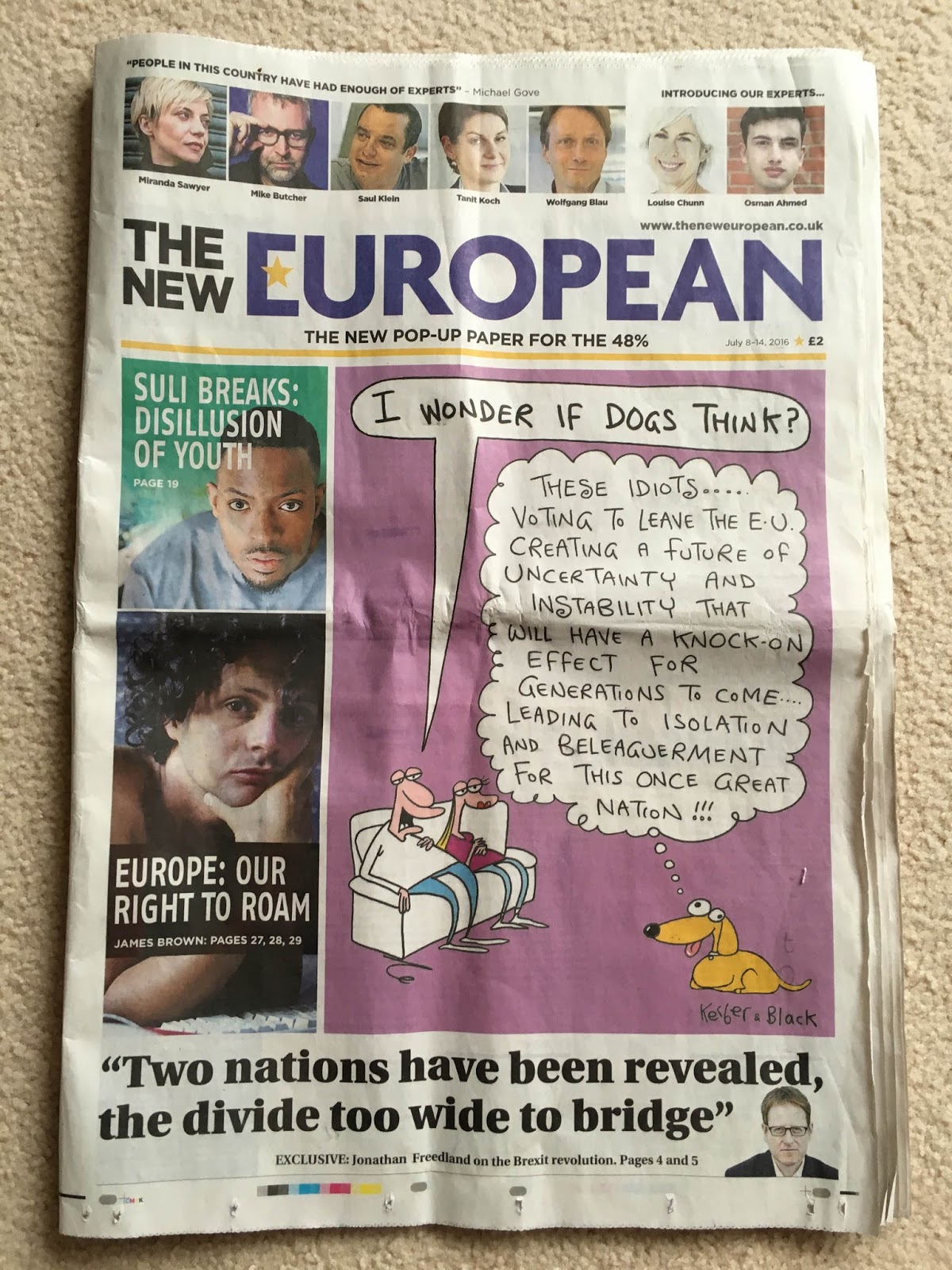

I ordered a copy of issue one (they're being mostly stocked in pro-Remain areas and this neck of the woods is 'Brexit central' so I doubt we'll see one in the shops) but didn't know quite what to expect. Had they had long enough to get it all together? Was £2 a bit steep? Would it all bit of a moan-fest?

Luckily my fears weren't realised and what popped through the letterbox was actually a cracking paper. There's a lot in it, a good range of columnists and a surprising variety of content. Matt Kelly and co deserve an awful lot of praise for doing all of this in such a short space of time.

The comparison with the New Day couldn't be starker. I felt that was always struggling to accept who it was aiming at and what it was trying to do. This has a clear identity and delivers a fresh batch of content that should go down well with its audience.

I liked the broadsheet format, the in depth articles and the fact it wasn't trying to be something it was not. There's little attempt to recap or tell the news and it quickly moves into the meat of the paper by diving into the 'expertise' section. You get the impression that Kelly and the team know that its audience is fairly well versed in the ins and outs of referendum result - and instead focuses on encouraging them to consider why the result happened and how 'the 48 %' feel now.

The design feels about right and even though I didn't think the page one cartoon was great I applaud the bold attempt to do something different with the splash. It certainly feels a European thing to do.


It feels like there's definitely enough life in this topic for the initial four-title run (and perhaps more besides?), with an attempt to look at some of the regional complexity that the national press barely understands and offer a view from commentators in Europe too. Indeed, the double page 'view from Germany' was certainly a highlight of the first edition for me, with Bild editor Tanit Koch offering a fascinating insight into her paper's coverage.


I also quite like the paper's cheeky side. Whether it's proudly railing against Michael Gove's anti-expert comment or highlighting some of the negative pre-launch tweets under the header 'do leave' on page two, these touches hinted at a paper with a playful confidence and a clear voice. It also benefits from signing up exclusively non-politicians to help it carve out a different sort of analysis to that you'll see elsewhere.

For me, the referendum debate has thrown up an interesting side story about the way we consume news - something also covered at length in Katharine Viner's superb Guardian Long Read this week. The New European touches on this with its Reality Bytes page, looking at the way in which Twitter and Facebook give us a blinkered view of the news and opinions of others outside of our circle of friends.

If The New European is anything is anything to go by then maybe there really is life in print yet. This life, as with magazines, comes in 'niche' publications that reach out to a well-defined audience and do it well. It's what makes Private Eye a success - alongside the likes of the Spectator, New Statesman and Economist - and this paper delivers on this score too.

How much life there is beyond the initial four-week run probably depends on what happens next with Brexit as well as, of course, sales.

If issue one is anything to go by, this will have at least been a more-than-worthy experiment - allowing people to find a fresh voice at a time of great confusion. History, as they say, is normally only written by the victors. This fights against that tradition.  It'll be interesting to see if the sales go well and what, if anything, happens after issue four. I'll certainly be back for the next three.

Friday, 8 April 2016

The Panama Papers coverage has been superb but what next for our papers?

There are those who love nothing more than to scoff at the Guardian, I know. Sometimes with very good reason too. But the paper deserves to be applauded - and probably awarded - for its superb coverage of the Panama Papers this week.


This story - the mass leak of data from Panamanian law firm Mossack Fonseca - is one of those classic cases in which the printed press come into their own.

Sure, the material was available online and was covered on TV and radio extensively but this was a complex and detailed unfolding story. It was the sort of story that demands sitting down and going over several times to truly understand. Snippets can too easily be missed online while the broadcast media is a format that dictates the pace to you, rather than the other way around, and doesn't always allow for the level of detail the Guardian managed in print this week.

I don't buy a paper as much as I used to these days but have parted with £1.80 everyday this week and have thoroughly enjoyed it. The story has grown and evolved throughout the week, like a slow-burning Night Manager-esque thriller with a key difference. Most of the people mentioned have done nothing illegal.

The Guardian's coverage leaves you in no doubt of the fact that much of the information unearthed by the Panama Papers - shared with them by partners at Süddeutsche Zeitung - is perfectly above board. But that, for me, doesn't detract anything from the story. In fact, this feels like a watershed moment where people across many countries question what is and isn't right and why the law allows the rich and famous to manage their finances in this way. It has opened a debate about what should be legal and what is morally right too. For all that to be decided, we need to shine a light on this secret and largely unknown - to you and I anyway - world of offshore money and accounts. That's not to mention the lessons for David Cameron in handling the questions he's faced this week.

The story might also come at a watershed moment for the industry itself. It has not been lost on me that this may even be the last - or one of the last - big stories that will be published in this way as journalism addresses its future.

Perhaps buoyed by the Panama Papers coverage - or by the demise in print of the Independent - the Guardian today revealed that its cover price will soon be £2. That price feels symbolic, a figure that belongs to a 'premium product'. While I've been happy to shell out £1.80 every day this week, the price of the print paper is one of the factors that stops me being a more regular reader. I've bought this as a 'treat' because of the story and couldn't justify £10 a week every week.

In some respects I feel sad typing that. The modern, internet age has to come to terms with the fact that quality journalism costs money. By delivering such a good offering online for free the industry has shot itself in the foot a little and has now got to grapple with how to fund itself going forward. I say now but this was a question many have been wrestling with for some time, certainly as long as I was a journalist.

This is clearly an important time in the history of newspapers. The Independent and Independent on Sunday are no longer on the news stands every morning having taken the bold move to go 'online only'.


I read both titles' final editions with a tinge of sadness but, of course, am fully aware that it's people like me not buying these papers which means they cease to exist in print. Both bowed out with dignity, packed with quality writing on the sorts of causes and issues that have been an important part in their stories. They did themselves - and their proud joint history - justice.

In many respects the Indy has done what many others must have considered. It's a bold step but everyone in the industry has presumed some, if not all, papers will have to go online to move with the times. Sometimes 'going first' isn't the wisest move but I hope they find a way to make it work. The quality of the likes of Cockburn and Fisk is simply too good to disappear and the spirit of campaigning journalism mustn't be lost because it's no longer committed to paper. Is it naïve to hope the essence of the paper will live on? Perhaps. But if the Indy pulls it off it'd be some coup.

There is one more print milestone for the Indy, however. Tomorrow (April 9) marks the last of its editions of the i paper. This concise spin-off has been a welcome addition to the news stands and is a title I've regularly turned to as a solution to my lack of cash and time to invest in reading the chunkier papers. From Monday the torch is passed to Johnston Press. It'll be fascinating to see what - if anything - changes as a result. Hopefully very little. It'll be a huge challenge for the regional publisher (my former employer) to take on a national title.

Then of course, we've just seen the launch of the New Day. From what I've seen of the title - and it doesn't feel aimed at me so I'm probably not the best judge - it will take a while to find its place. I think its best editions so far have come when it has taken a big issue - one that maybe other papers aren't tackling - and done some big to highlight it. In a nutshell, that takes the ethos of the Indy and channels it to a different audience and is to be applauded. The price seems high (this seems a theme, maybe I'm a cheapskate?) and it'll be interesting to see if its lack of website helps or hinders its success.

The print Indy disappearing, the Guardian cost cutting and raising its print price to premium levels, the i beginning a new life and a new newspaper have all made for an intriguing few weeks. This is far from the end though. The Times, for example, recently announced it is focussing less on 'breaking news' and more on delivering 'editions'.


Friday, 1 April 2016

April Fools' Day...the old joke that's worn thin

In December I turned a bit 'grumpy old man' and listed off ten things that were almost as overrated and underwhelming as New Year's Eve. I ought to apologise. Not for being miserable, but for forgetting to put April Fools' Day on the list.

Don't get me wrong, I don't mind a spoof or a well-thought out prank, and it's fair to say that some people use this day to perform these, but let's face it, the vast majority are tame, lame or just plain garbage.

At my first newspaper April Fools' Day was approached with severe caution. Some years before I joined the paper had decided to prank the readers by announcing a new congestion charge was coming to the town. To make matters worse, the phone number given out for queries took people through to the newsdesk. Safe to say it didn't end well, with days and weeks of ear bending hammering home the extent to which the 'joke' backfired. You try telling and angry person 'sorry, we were just having you on' and see how ready they are to laugh it off.

For that reason, future attempts were pretty timid - including one year in which a whole sponsored pullout was produced with the advertiser in on the overly-laboured joke.

The thing is, while not every paper will have had its 'congestion charge moment', most are hamstrung by fear of putting their foot wrong. Put yourself in the reporter/editor's shoes: you've got to write something funny and sort-of believable but also that won't offend people either by making them the butt of the joke or leaving them annoyed when they realise it's not real. That last point is harder than ever in a world where people love nothing more than to be offended.

As a result you end up with 'safe jokes' that all have to contain some sort of anagram of April Fool to make it bleedingly obvious. (my last attempt still exists here) Some contain nice puns or cheeky ideas but the reader is in on the joke from the start rendering it all largely pointless.

Today even Google managed to balls up an April Fools' Day prank. Brands that produce their own content are realising the same problem that newspapers faced in that being believable isn't always a good thing.

Essentially the best way to do a spoof or a prank properly is to pull it on any day but April 1. That alone should make people realise that Fools' Day is a naff waste of time.

Friday, 20 March 2015

10 musings on Osborne's pre-election Budget

George Osborne has brandished his big red box for the final Budget of this coalition Government, delivering his all-important speech after the most well-worn photo opportunity in history (can't they think of something new?). His hour-long speech can't really be analysed outside of the context of the election, now less than 50 days away but was this speech in any way significant?

Here's 10 things I was left pondering in the aftermath:

Targets: I imagine if I decided to only pay half of my mortgage payments for the next few years the bank wouldn't be entirely satisfied if I blamed external factors and promised that I was definitely now back on track and 'walking tall' again. The simple fact is Osborne and the Tories promised far more than they could actually deliver when trying to win our votes five years ago. I don't buy this 'well we had a huge deficit to deal with' line either. I'm pretty sure the desperate state of the economy was known - and argued over - at the last election. George has delivered about half of his target to eliminate the deficit - a figure that was something he campaigned against at the last election. Still, it's churlish of Labour to criticise him too much for this since he's delivered the sorts of numbers they were planning to achieve if elected in 2010.

Banks: Osborne boasted about the fact Labour was the party that bailed out the banks while his party would get taxpayers' cash back by selling our stake now things had got better. I couldn't help but think this was a strange boast. Was the Chancellor saying he wouldn't have stepped in to prevent banks going out of business? Or was he praising the opposition - implying he was reaping the rewards of their decision. It certainly seemed a silly thing to say.

Gimmicks and giveaways: No gimmicks, no giveaways eh? Well, not unless you count the penny off a pint of beer, scrapping the paper tax return or the ISA for first time buyers. There were others too. Why say it when you know it's not true?

Good ideas: One of the problems with our political system is that our 'Government vs Opposition' format means the response to any Budget, or indeed any Government policy, has to be to oppose it. Labour may well have liked the Help To Buy ISA, say, and want to do that themselves but they don't feel they're able to say it. It means we treat every thing as a black and white 'right and wrong and ignore more sensible grey areas in the middle. Some have said the new ISA will simply encourage people to get into debt but those are probably not the people struggling to get onto the ladder. That money will be welcome to the people who can afford to pay off a mortgage but can't afford the up front cost and it isn't exactly a case of chucking away free money to people without requiring them to save some themselves. Raising the personal allowance on Income Tax will be welcome to many as will relief to savers who have suffered from low interest rates.

Pick your stats: Both parties have unearthed their own measure of 'standards of living' that prove we're either better or worse off than 2010. There's a surprise. You really can prove anything with statistics it seems. My favourite line is 'more people in work than ever before'...conveniently forgetting that there are also 'more people than ever before'.

Europe: It's often said that the crisis in the Eurozone was one of the things that served to delay the our recovery from the economic crisis. I wonder if, in any of the tables, graphs or sets of numbers produced in the last day, anyone has an accurate prediction for the impact on the Eurozone economy that our much-vaunted renegotiation might have? Just a thought...

Ideology: The Budget - and subsequent debate - did shine a light on a small point of difference, ideologically, between the main two parties. It's often feared that 'they're all the same' but, when it comes to the economy it's not quite true. The Tories think there's still scope for some fairly big cuts, largely in welfare, as they aim for a smaller-than-previously-promised surplus by the end of the next Parliament and larger cuts to debt. Labour would spend - and, yes, borrow - more and move towards a balanced budget much slower. Not that either of them like to being presented in such a simplistic way of course. Whether that's a clear enough difference to matter when it comes to votes is another matter and it'll be interesting to see what the Greens, UKIP etc come up with as an alternative given that they have the freedom to be more creative.

Cliches: Why are all families 'hard working families'? It's just one of a host of cliches that was littered through the speeches of both sides of the house. And is George really still peddling that awful 'we're all in this together' line?

Commons: The behaviour of MPs in the Commons never ceases to amaze. To see grown men and women shouting over each other and trading lame jokes and one liners is an unedifying spectacle and does nothing for the calls to increase the wages of MPs. They should sit back and watch the footage and be ashamed of themselves.

Papers: The day after a Budget is always a great time to grab a newspaper - particularly one of the 'serious' titles who produce big pullouts at short notice packed with analysis, case studies and the sort of detail the telly simply doesn't have time to go into. It must hard work but great to be a part of. I'm also impressed by the amount the i packed into its edition. You have to take your hat off to those involved. The mid range papers seemed to struggle in comparison - with the Mail sporting Osborne as the Teletubbies sun in a badly dated cultural reference and the Express going for something incredibly dull and formulaic. I'd not seen the latest Money Supermarket ad (unlike most of the population it seems) that inspired The Sun front page so was briefly baffled by the odd image of Osborne in a pair of shorts. I still don't think it's one of their better efforts. The serious papers came out even more favourably in comparison to some uninspired offerings - maybe the lack of a clear soundbite or theme gave those eager tabloid subs little to chew on?