Tuesday, 30 August 2016

David Copperfield: A delightful Dickens classic

Has anyone else got a book that has been sitting on the shelf looking at them for a long while? In truth I've got several. But chief on the waiting list was David Copperfield. Until now.


A fair few years ago (7 or 8 I think) now I worked my way through the Pickwick Papers (having previously read Hard Times, Oliver Twist and bits of Great Expectations) and loved it. I know it's not seen as one of Dickens' best but I found it funny and really entertaining. I loved the serialised format and the weird and wonderful tangents it explored. I vowed that David Copperfied would be next and then, as usual, failed to meet my reading ambitions.

After a recent cull of the shelves, Copperfield called louder than ever so - despite being a hefty read - he was packed for my holiday and my promise was finally fulfilled.

I'd prepared for a return to a 'classic' by churning through a quick throwaway page turner but needn't have worried about getting back into the Dickens saddle.

Actually I think anyone daunted by taking on a 'classic' should consider, as I did throughout David Copperfield, that the best novels from the past feel no different to a book from the modern day. The reason such books enjoy their lofty status is because their tales stand the test of time. Dickens' observations are surprisingly and refreshingly modern, meaning that it's very rarely a puzzle to pick through the language.

If the Pickwick Papers was something of a jolly jape and Hard Times a political commentary, this was something different entirely with a different strain of observations on the world.

At face value it's the biography of the titular character but there's more than the face value narrative to enjoy here. In fact, for me, the real joy of the story comes from the cast of colourful personalities - the people he encounters throughout his life. From the dependable Traddles, ever-wise Agnes, crazy Aunt, malevolent Murdstones, sycophantic Heep and amusingly verbose Micawbers to the loveable Peggottys, everyone seems well sketched out and provides a pleasure. Dickens deploys a searing sarcastic wit to help to establish each of his characters, making for a merry band of memorable friends and foes along the journey. The backdrop - be it Suffolk, Yarmouth, London or Kent - is also brought to life in a vivid way.

Copperfield himself is, at times, a frustrating character. He latches himself onto the wrong friend in Steerforth and, arguably, the wrong woman in Dora - both times eventually realising the virtues in Traddles and Agnes in their place. He's also a fairly tragic figure - losing his dad, mum and wife along the way in the book's most emotional passages - and is someone who earned my respect by becoming a shorthand parliamentary reporter.

There's fun to be had in attempting to spot which events are inspired by Dickens' own life, and this personal touch must surely add to the richness of the readers' experience. Still, at its heart, this is a tale of relationships - between parent and child, friends, partners, colleagues, enemies - that rests on the people Copperfield comes across.

It was rewarding to finally tick this off my hitlist and pleasing that it didn't disappoint. The next step is to delve back into a meaty non-fiction text and dust off a history book that has been waiting to be plucked from the shelves. Hopefully that ambition won't take so long...



Friday, 15 July 2016

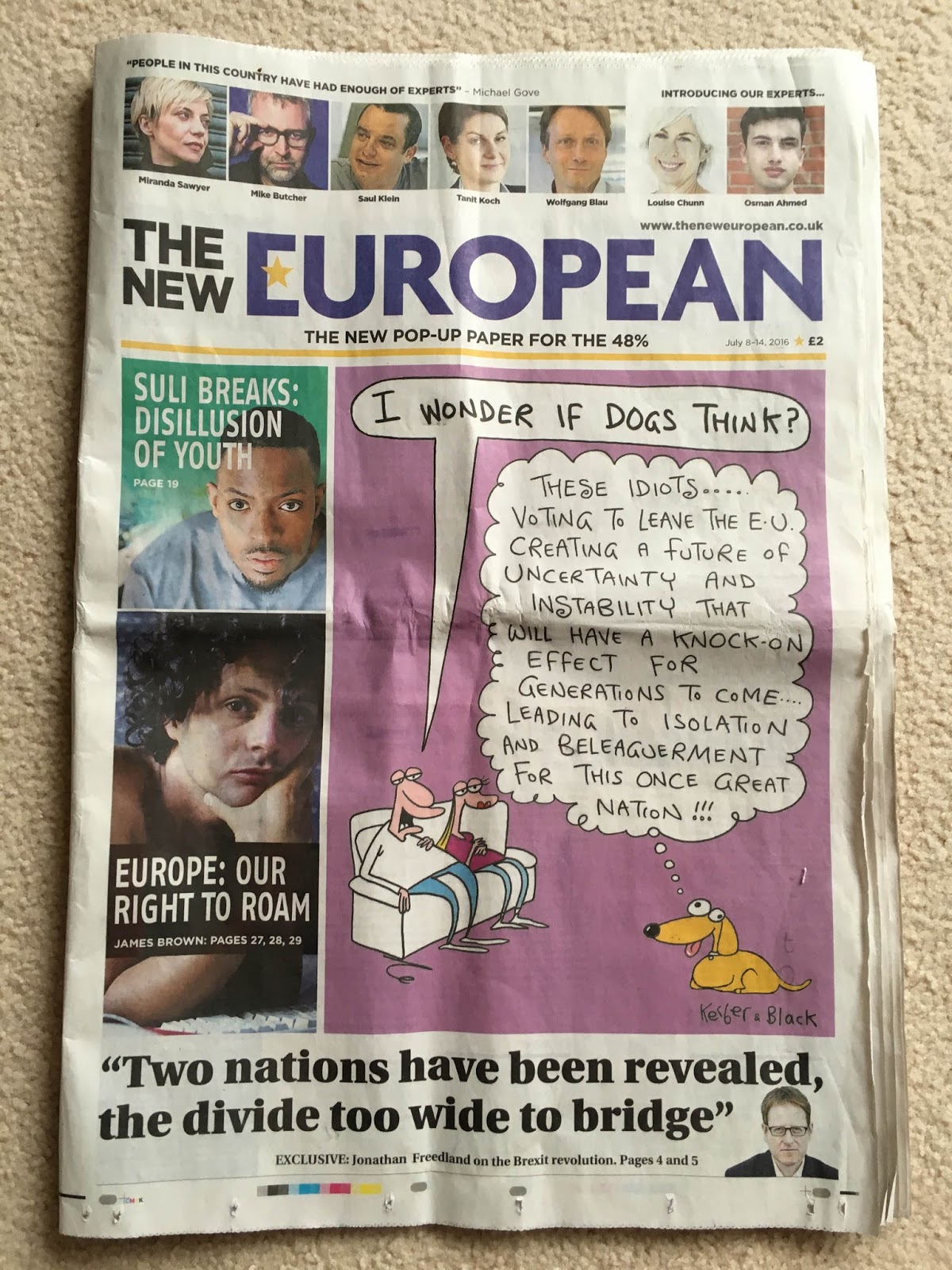
Reviewing The New European

After the ill fated launch of The New Day I think most people, me included, thought we'd seen the last ever launch of a print newspaper but then, out of the blue, came The New European.

The 'pop-up paper for the 48%' from Archant launched last week and I couldn't resist having a nosey at what they'd come up with.


I ordered a copy of issue one (they're being mostly stocked in pro-Remain areas and this neck of the woods is 'Brexit central' so I doubt we'll see one in the shops) but didn't know quite what to expect. Had they had long enough to get it all together? Was £2 a bit steep? Would it all bit of a moan-fest?

Luckily my fears weren't realised and what popped through the letterbox was actually a cracking paper. There's a lot in it, a good range of columnists and a surprising variety of content. Matt Kelly and co deserve an awful lot of praise for doing all of this in such a short space of time.

The comparison with the New Day couldn't be starker. I felt that was always struggling to accept who it was aiming at and what it was trying to do. This has a clear identity and delivers a fresh batch of content that should go down well with its audience.

I liked the broadsheet format, the in depth articles and the fact it wasn't trying to be something it was not. There's little attempt to recap or tell the news and it quickly moves into the meat of the paper by diving into the 'expertise' section. You get the impression that Kelly and the team know that its audience is fairly well versed in the ins and outs of referendum result - and instead focuses on encouraging them to consider why the result happened and how 'the 48 %' feel now.

The design feels about right and even though I didn't think the page one cartoon was great I applaud the bold attempt to do something different with the splash. It certainly feels a European thing to do.


It feels like there's definitely enough life in this topic for the initial four-title run (and perhaps more besides?), with an attempt to look at some of the regional complexity that the national press barely understands and offer a view from commentators in Europe too. Indeed, the double page 'view from Germany' was certainly a highlight of the first edition for me, with Bild editor Tanit Koch offering a fascinating insight into her paper's coverage.


I also quite like the paper's cheeky side. Whether it's proudly railing against Michael Gove's anti-expert comment or highlighting some of the negative pre-launch tweets under the header 'do leave' on page two, these touches hinted at a paper with a playful confidence and a clear voice. It also benefits from signing up exclusively non-politicians to help it carve out a different sort of analysis to that you'll see elsewhere.

For me, the referendum debate has thrown up an interesting side story about the way we consume news - something also covered at length in Katharine Viner's superb Guardian Long Read this week. The New European touches on this with its Reality Bytes page, looking at the way in which Twitter and Facebook give us a blinkered view of the news and opinions of others outside of our circle of friends.

If The New European is anything is anything to go by then maybe there really is life in print yet. This life, as with magazines, comes in 'niche' publications that reach out to a well-defined audience and do it well. It's what makes Private Eye a success - alongside the likes of the Spectator, New Statesman and Economist - and this paper delivers on this score too.

How much life there is beyond the initial four-week run probably depends on what happens next with Brexit as well as, of course, sales.

If issue one is anything to go by, this will have at least been a more-than-worthy experiment - allowing people to find a fresh voice at a time of great confusion. History, as they say, is normally only written by the victors. This fights against that tradition.  It'll be interesting to see if the sales go well and what, if anything, happens after issue four. I'll certainly be back for the next three.

Tuesday, 5 July 2016

Promises, promises: 11 failed pledges from both sides of the EU referendum campaign

What's a promise worth in politics these days? After writing my last post I started to think about all of the promises that had been reneged on during the course of the EU Referendum saga.


I came up with the following:
  • David Cameron told us he'd stay on regardless of the result. He quit within hours
  • The PM also said he would enact 'Article 50' but didn't
  • George Osborne said he'd need to draw up a 'Brexit budget' if we voted to Leave. He hasn't
  • Boris Johnson said the pound would be fine and the economy would be stable after the vote. It isn't
  • The mop-haired ex Mayor then weighed up standing to deliver on the result he'd strived for and backed out
  • Michael Gove repeatedly ruled himself out of standing to be Prime Minister. He then stood and stuck the knife into his old mate Boris
  • Andrea Leadsom once warned Brexit would be a disaster. She now backs it
  • Jeremy Corbyn promised to support the Remain campaign but has been accused of undermining its efforts and not-so-secretly wanting to be out
  • We were promised £350 million more a week for the NHS. We won't get it
  • The Leave campaign promised to control the levels of immigration. They probably can't
  • Nigel Farage has stood down, saying his work is done. It isn't. (He also insulted the people we now need to win over to strike a new deal for Britain, nice work)
That's pretty damning I'd say. I don't want to just criticise politicians, but they should look at the list above and begin to understand why many people don't trust them.

The sad thing is I doubt I've even covered them all. Feel free to point out any I've missed below...

Monday, 4 July 2016

How do we know what the electorate actually wanted from EU Leave vote?

Photo: Unsplash
Life very rarely throws up questions that have a black and white ‘yes/no’ choice does it? I can’t quite help think that this hasn’t helped with the EU referendum. With a question of such complexity and magnitude boiled down to one simplistic question, chaos was probably always likely.

I last blogged on the eve of the ballot. A lot has happened since hasn’t it? Yet one thing is clear, no-one really knows what to do next.

Whether I like it or not (and I’m still convinced that it’s a terrible decision) the electorate chose to Leave. The trouble was, while there is a mandate to negotiate an exit, it’s not clear what else there is a mandate for. What did the people actually vote for?

The black and white nature of a yes/no referendum also allows people to make sweeping and inaccurate statements about both camps. Remainers aren’t all whiners just as much as Leavers aren’t all racist. Yet, because the cap fits for some in those respective sides, others are tarred with the brush.

Some Leavers want a strangely very similar relationship to the EU to that we have now. Others want a Norway style deal, some are keen on a more distant position and others want us to be as far away as possible. Some won’t countenance ‘free movement’ of people, others are happier to accept this. All of this variation is under the umbrella of the ‘no’ in the yes/no vote... and that’s not even considering the shades of grey within those arguing for yes.

So, what do we do? Blunder along into a position that is bound to be unsatisfactory? That’s the way it seems. Consider this: a negotiation that adopts a Norway-style relationship is likely to upset the 48% who voted to Remain AND all of the most vehemently anti-EU elements of the Leave voters. The mandate suddenly becomes a little flimsy.

People like Boris Johnson certainly don’t have the answer. Having been royally shafted by his fellow Leaver Michael Gove, Johnson ducked out of the race. Yet, let’s face it, he had no idea how to implement the result he’d helped to win anyway. He’s probably relieved to be able to snipe from the sidelines rather than having to do anything, passing the poisoned chalice to a colleague in the process.

Gove is a man who regularly repeated the assertion that he doesn’t think he is up to the job and proved too toxic to run the Department for Education. I still don’t think he really wants it. He’s probably achieved what he wanted by dashing Boris’ dreams. A playground-style rivalry played out at the highest level.

It’s certainly a precarious position. David Cameron – having let loose a yes/no question to this tricky topic – is the lamest of lame ducks. A decision on Heathrow and a debate on Trident have been parked until his successor is named. Nothing, it seems, can be achieved until the politicians sort out their squabbles. A final failure that will surely define Cameron’s premiership.

Then there’s George Osborne. The Chancellor had failed to wipe out the deficit in five years of ‘the coalition’ as promised and now, post Brexit, says it won’t happen by 2020 either. His sole purpose destined to be left unachieved. He now seems to think that by repeating the phrase ‘I want to offer reassurance’ that people will actually feel reassured. Why not try giving us some words and ideas that are actually reassuring George? Is it because you’re keeping your powder dry in the hope of clinging on to a job?

And what to make of the mess on the opposition benches? Right now, in the country’s hour of need, there is no opposition and no Government. Cheers guys.

I know some people feel Jeremy Corbyn has been hard done to in recent days but I can understand why his parliamentary colleagues have lost faith in him. His performance during the referendum debate was poor. We’re told he’s a man that sticks to his principles and convictions yet you get the impression he is a Eurosceptic and is happy to leave. So, why not say that? Irrespective of that, the man doesn’t command enough of a party to form an effective opposition any more and has to go. It might not be nice but that’s politics.

I can understand why some people have chosen to march, demonstrate and protest. It seems ridiculous that others now say they shouldn’t do so having argued that they are ‘pro democracy’ during the referendum. The trouble is that I doubt there’s a consensus solution among the marchers about what they think should happen next either.

We’re left awaiting the result of the Conservative Party leadership election to see how we’ll go forward. The final two candidates will, at least, offer differing visions of the future relationship with the EU but it feels a little unsatisfactory that 150,000 party members will get to choose that vision (having had their ‘final two’ whittled down for them). Some grim irony given that we apparently voted to end the rule of unelected and unaccountable figures.

Maybe we should’ve been given a better range of choices in the referendum? Maybe we should never have had one in the first place, leaving the politicians we choose to represent us to make the tough decisions on our behalf? Maybe we should be given a chance to say whether we agree with the final deal thrashed out with the EU? Maybe we should all pretend this never happened in a very British way and try to move on? Maybe Remainers should just step back and hope things aren’t that bad? Maybe Johnson and Farage should’ve had the decency to see through what they started?


So many maybes, so few answers. We’ve said ‘no’ to a question that really wasn’t a yes/no problem and all it has done is throw up other more complex questions. Questions of the nature that probably should’ve been thrashed out before the vote instead of tawdry nonsense, spun statistics and guff written on buses.

Wednesday, 22 June 2016

Some thoughts on the EU Referendum


Sometimes this EU referendum has got so tiring that you might just be best placed to choose whether you are ‘in’ or ‘out’ based on the status of your belly button.

Churlish perhaps, but not less nonsensical than some of the points being made as we approach polling day.

Before we get much further I might as well chuck my cards on the table. I’m voting Remain on Thursday and not just because I’ve got an ‘in’ belly button (too much information, sorry).

I tended to shy away from making my political views on individual topic too well known when I worked in journalism because I honestly made an attempt to be an impartial observer. I think/hope I managed that. Not that I expect many people care too much either way about my two penneth now but, you know, it’s cathartic to type it out.

The thought of Brexit actually fills me with dread. I’ve always thought that this debate should really be about their side proving, on the balance of probabilities, that we’d be right to make such a big change as leaving the European Union. I honestly don’t think they’ve got anywhere close. If you're still uncertain now then I'd say they've not done enough to persuade you either.

Neither side got off to the best of starts it has to be said. When the words 'Hitler' and 'World War Three' were thrown around by Boris Johnson and David Cameron you got a feeling for the sort of campaign that was coming.

I shan’t waffle on too much about experts because you’ll undoubtedly have seen all that elsewhere. Still, I do find it worrying to see the casual nature to which they’re all brushed aside by some on the Leave side. Of course experts have been wrong before, but it’s insufficient to simply use that line alone to oppose what they are saying. Whatever you think of the detail and some of the longer term forecasts, I struggle to formulate a case for thinking we’d not be worse off by leaving. I don’t expect the weather forecasts to be 100% accurate but if they say it’s going to chuck it down I pack a coat. What the economic forecasters say about Brexit makes me think some stormy clouds are looming if we follow that path.

Many people ask for ‘facts’ to help them make their decision. We’re being asked to vote on the future, of which there are no hard and fast ‘facts’. We have to weigh up the forecasts, predictions and promises from politicians, pundits and experts and it’s not really acceptable to complain about this if we don’t find it easy. It’s our right to vote and our duty to find the information we need.

Then there’s the tosh about £350 million. There have been exaggerations on both sides but this is the biggest whopper of the lot. Presumably it was too much hassle to get the Battlebus repainted with the true number (which they could still have used for the basis of their case) so they’ve had to stick with a ‘stat’ that just isn’t true. That this line unravels so quickly upon examination makes you question the judgement and accuracy of the rest of the campaign.

So much is confusing about the whole referendum debate. Most recently we saw Boris Johnson calling for the UK’s ‘independence day’ while, during the campaign, harking back to the nation’s ‘better days’. You know, when we had the empire. The same empire that the Americans cut loose from in their ‘independence day’. So, are we voting to come out of the EU because it has got too much like the British Empire in order to try to rekindle better times we had as the British Empire? My head hurts. Maybe Boris just meant he had a ticket to see the new film at the cinema on Friday when the tawdry campaign finally ends?

My head also hurt when I saw Nigel Farage’s hideous ‘Breaking Point’ poster but for a different reason. I’m all for robust campaigning but that was a step too far. Whether it was intended to or not, it reached into the nastiest of propaganda playbooks, the sort that whips up hatred of others. Everyone behind that poster – and I’m well aware that many Leavers were equally unsettled by the image – should be utterly ashamed of themselves. Look in the history books and you might see some similar images. You won’t be happy to see who used them.

I wish I’d had a pound for every mention of the ‘Australian style points system’ – the cliché of choice during the immigration debate. As someone who worked in Boston in Lincolnshire it would be wrong of me to argue that everything about immigration has been positive. Boston hasn’t had the investment it has needed to keep up with its population expansion and that still hasn’t been addressed. It isn’t alone. Yet this isn’t the fault of the migrants. The vast majority of them work hard and pay enough into the system to help fund better infrastructure.

Unemployment is, thankfully, low and the jobs being done by EU migrants would be necessary if we left the EU. I doubt those who yearn for ‘control’ would get what they want by a Leave vote. The predicted economic dip is definitely not worth the risk for such a flimsy promise.

The EU is far from perfect but too much of our view of it is clouded by caricature of the sort peddled by Boris himself as a journalist. ‘Brussels bureaucrats’ are much fewer in number than ‘Whitehall bureaucrats’, for example, and it is not strictly true to label the EU as unelected. We chose our MEPs (although too many of us don’t bother) and we also chose our Governments who then represent us at an EU level and also pick our commissioner. If we don’t like our MEP we can vote them out and if we don’t like the deal we are getting in Europe then we can kick our Government out and elect one that can do our bidding. Criticise the EU if you like but let's avoid such generalisations.

The EU has been a handy bogeyman for governments to hide behind and blame for all of our ills. Much of that mud has stuck and Cameron and co are now struggling to undo it.


Journalist Robin Lustig wrote a piece on the Huffington Post that resonated with me in this respect. It contained the following passage:

Between 1999 and March 2016, the UK was indeed outvoted in the Council 57 times. It abstained 70 times, and voted with the majority - wait for it - 2,474 times. In other words, over a roughly 15-year period, the UK’s elected representatives, members of a government that has to face the electorate every five years, voted in favour of 95% of the laws passed in Brussels.


So the UK Government does get its own way in Europe. We aren’t dictated to at an EU level. Add that into the fact that we’re not in the Eurozone or part of the Schengen agreement, throw in a few other opt-outs and rebates and you realise that we currently have our European cake and eat it. We won’t get better terms from the outside and that could diminish the trade, education and research relationships we benefit from.

Then there’s the fact that the likes of Michael Gove rail against the daily influence the EU has on policymakers. If the EU is so controlling, how did Gove manage to completely overhaul the schools system? Surely such fundamental change should be impossible with Brussels on our back? Or there’s HS2, benefits changes, tuition fees, military air strikes…big decisions that we’ve made for ourselves in our Parliament. It doesn’t add up to me and smacks me of people using the EU as an excuse. If we vote out, who will the next scapegoat be?

Finally, this whole ‘we want our country back’ nonsense makes me wince. It’s not unpatriotic to want to stay in the EU. We should stay, work with our neighbours and fight for a better future together. Walking away isn’t patriotic or anything to be proud of. I want us to play a full part of the world we now live in if that doesn't sound too woolly.

The world has changed since we joined the European project – globalisation has happened and we can’t ignore it. Barack Obama probably summed it up best when he said that our voice is amplified by being in the EU rather than being diminished. It’s the way we can have an influence that’s relevant to the day and age we live in. It won’t feel any more like ‘my country’ if we vote out, quite the opposite.

I don’t doubt that many people will think I’m talking nonsense. That’s the beauty of free speech. Let's still be friends though, eh? See you on the other side on Friday…

Thursday, 2 June 2016

Hopefully not the last of those super Shadow Puppets

It feels like we need to enjoy The Last Shadow Puppets while they're here. Given their form, the respective members of this supergroup will soon be back with their own individual projects and, no doubt, leaving us waiting years for more.

That added a little added spice to their gig at De Montfort Hall on Tuesday night. Not only did we get to see a class act at the top of its game - but also a class act that so rarely comes out to play.

It feels like a second album is a good time to see any band. By then, not only does it have a bank of songs to fill a good set and confidence in its own performances, but it isn't too far removed from those joyous first hits that attracted you in the first place.

So it proved with The Last Shadow Puppets. The mix of the more retro songs from The Age Of The Understatement and the newer material from Everything You've Come To Expect made for a set that rattled along at a real pace.


The band's key players - Alex Turner and Miles Kane - offer up contrasting performances. Kane is the solid, serious musician, with the heavy lifting on the guitar. Turner slips into the frontman routine and, once he got into it, belted out the hits in some style.

There was little interaction with the audience - they just got on with delivering the goods - but Turner did make me chuckle by feigning to praise the city's football team before actually bigging up Kane. If it's possible to hear a glint in the eye then this was it.

The title song from the new album was one real highlight, as was The Dream Synopsis. Yet the surprise for me was Sweet Dreams TN, a song that was really lifted by a brilliant live performance. I'll certainly appreciate it more in future now. In fact the whole of the second album crackled with a real energy and came across well proving the group is no one album wonder.


Meeting Place brought the curtain down in typically class fashion, with a slick and memorable parting shot to round off a thoroughly enjoyable evening.

They didn't perform the excellent Pattern from the new album or Separate and Ever Deadly from the first album, but then that's The Last Shadow Puppets all over isn't it? Always leaving you wanting even more.

I do hope there'll be more from the group. It'll be worth the wait, no matter how long it is this time.

Thursday, 12 May 2016

What I learned from...Why England Lose & Other Curious Football Phenomena Explained


My best laid plan for monthly blog on a book I've read hasn't exactly gone to plan. Still, better late than never I've come to the end of Why England Lose & Other Curious Football Phenomena Explained by Simon Kuper and Stefan Szymanski.

I'd borrowed this from a friend - who clearly bagged a bargain looking at the sticker - so it had come highly recommended. The book is essentially an attempt by Kuper and Szymanski to look at football with an economist's hat on.

The beauty of it is the balance struck by the authors. Economic theories and methodologies are explained in a pretty simple way, helping you to keep up with how and why the pair come to their conclusions. It's clever without being dry and insightful without being patronising.

The answer to the title question is, in short, that England win about as many games as they should given the size of the country, experience of international football and strength of the economy (the three key factors they use to gauge whether a nation meets its expectations). It'll be well worth bearing that in mind during the hype, hope and heat of the Euros this summer.

From a Forest fan's point of view, it's interesting to see Brian Clough and Peter Taylor held up for their mastery of the transfer market.

Quoting Peter Taylor's book 'With Clough By Taylor' it looks at three lessons that clubs can learn from Forest's dynamic duo. Those being:

*be as eager to sell good players as to buy them - spotting deterioration early
*older players are overrated
*buy players with personal problems at a discount and then help them deal with those problems

Plenty of clubs could do with a read of that section before blowing billions in this summer's transfer window.

Other issues range from looking at which footballing nation performs best (spoiler alert: Iraq does pretty well), an explanation of the winners of the European Cup and a look at how economists look at penalty shootouts.

Not every bit completely works and some of the information is understandably dated now, seven years on from publication, yet this was a fun read. It plays with some of football's conventional wisdom and offers a genuinely interesting sense of perspective. It's well worth a read, especially if you can find it at that place.