Monday, 29 May 2017

Forget the rest, Theresa May hasn't proved herself a worthy Prime Minister

It's annoying when you start out on a task that should be straightforward but ends up being harder than you'd hoped. Maybe you've left plenty of time to get to an all-important meeting but your car decided to pick the worst moment to break down, or perhaps a short and simple DIY task swallowed up days of your life that you'll never get back despite saying '2-3 hours' on the box. Or maybe, if you're like me, you start off a supposedly 'easy' crossword and allow the ruddy thing to take over your life. Anyway, you know the sort of thing.

I can't help thinking that that's the way Theresa May feels about the current General Election. It was supposed to be a walk in the park for the PM - a 'coronation' as the Lib Dems put it. Yet, it's good if she's starting to feel under a bit of pressure. Frankly, it serves her right.

Photo: Unsplash


Let's not kid ourselves, this election was called because she felt she could destroy the Labour party and return to the Commons with a massive majority. It's a vanity election to feed her ego and give her her own 'mandate' - while also helping her to dilute the influence of some critical back benchers and avoid going to the public for the next election too soon after the Brexit negotiations.

None of those reasons are remotely to do with 'democracy' or us, the mere voters. It's all about May. Indeed, it's estimated that the 2010 election cost £113 million to run - if it's anything like that this time then that's a lot of money to feed your ego. And people thought her shoes and trousers were expensive.

The reasons she gave for calling a snap election were laughable. She said she made the decision because the opposition had said they were going to oppose her (shock, horror) and that although the nation was united in favour of Brexit, the Commons wasn't. The latter point ignores the fact that the Commons voted in favour of her when it came to Brexit, without managing to land a single amendment to dent her progress. MPs, I'd argue, looked much more united on the subject than voters. We have to hope that she doesn't really believe that the opposition should be silenced - or the 'saboteurs crushed' as the Mail put it.

Luckily, I don't think she does believe that. In fact, I'm struggling to see what she does believe in, apart from herself. I've read a few articles in the likes of New Statesman in which writers have started to try to understand 'Mayism' and what makes the PM tick. While they've been well-written - and put forward a case for a politician who is more interventionist and in favour of the power of the state than her predecessors - I can't help thinking that hers is an empty agenda. She spouts robotic banalities such as 'Brexit means Brexit', 'strong and stable leadership' and 'coalition of chaos' that demean public debate offering nothing of substance. I think she went into the election thinking she could get away with doing as little as possible - letting Labour 'beat itself'.

Indeed, at the start of the campaign May toured remote village halls, turned up at factories after the real workers had gone home and denied local newspaper reporters the chance to ask proper questions as she executed her 'safety first' strategy which avoided 'real people' at all costs. That might be fine as a tactic, but we should be demanding much more. Theresa May called this election and it's only right that she should tell us more about what she'd do with the power she craves. Bizarre non-priorities such as fox hunting and grammar schools have been thrown out by way of distraction.

The Prime Minister also immediately dismissed all chance of a head-to-head debate with Jeremy Corbyn on TV. While I don't necessarily think a TV debate is the be all and end all, it is laughable that May wants to frame the election as a choice between her 'strong and stable leadership' and Jeremy Corbyn's 'coalition of chaos' while not having the guts to show us why she's stronger and more stable than him. Again, we deserve more. If you want to make this a presidential run-off with your face on every poster and leaflet, at least have the decency to conduct a campaign that reflects this.

Speaking of character, if Theresa May wants to make this election about the personalities of the prospective leaders then it's time to scrutinise her own record. She was the Home Secretary in charge when police numbers were cut back, when the Government failed to meet its own immigration targets and presided over the pitiful 'go home' vans that shamed us all. She campaigned for Remain - half-heartedly and maybe out of loyalty to David Cameron but still in favour of Remain - and now wants a full-on hard Brexit. She repeatedly said she would not have a snap election and here we are, heading to the polls on June 8. The Government she led seemed to achieve very little bar upsetting the people we need to negotiate with for the next two years and, indeed, her administration's only Budget ended in disaster, with a huge U-turn on a tax rise for the self-employed. Clearly, being Prime Minister or Home Secretary isn't easy - but we shouldn't allow May to go around boring us to death with a 'strong and stable' mantra that deserves to be contested.

That's before we even come to the manifesto and the row over the 'dementia tax'. I can't help thinking that she became a victim of the hysteria she's otherwise thrived on over this issue. The policy itself seemed a flawed version of other schemes floated by politicians who have desperately tried to solve the complex issue of the funding of care for an ageing population. Maybe it was flawed because May and her team were so complacent about the election result? Regardless, it quickly drew criticism from opponents (or should that be saboteurs?) such as the Mail on Sunday. The Tories, however, undermined their own wish to avoid this being framed as the 'dementia tax' by buying up ad space on Google to capture searches for 'dementia tax' and legitimising its use in the debate over this issue. The mud stuck and May and co managed the unusual feat of performing a massive U-turn on a manifesto policy before the election had even taken place. It was a poor policy that needed to have been better thought out but, at the first sign of trouble, she panicked. I imagine the EU negotiators must be rubbing their hands with glee at such a mess.

What of Brexit? The biggest issue of our times and the matter that was so serious that it, apparently, caused the election in the first place? Very little of substance has been said about this. Theresa May wants permission to do whatever she wants with the negotiations. She is basically asking for a blank cheque from the electorate (maybe literally given the possible size of the divorce bill). It'd be nice to know why some options have already been ruled out. Why couldn't we try to stay in the Single Market? Will we end up like Norway, opting 'out' over immigration as they do with fishing? We seem to have spent longer talking about threatening to walk out of the negotiations than anything else so far - a prospect that would surely be economically devastating. A badly-handled Brexit has the potential to render anyone's manifesto pledges impossible and wreck the public finances. I have a horrible feeling that David Davis, Boris Johnson, Liam Fox and Theresa May just aren't up to the task, frankly.

Now it seems as though Theresa May's campaign has returned to its back-up plan. The 'bore them to tears' stuff allowed Labour to present some policies and grab the agenda and the manifesto back-fired massively. With that in mind, it's now going to be a case of attacking Jeremy Corbyn as loudly as possible. Again, this might be effective but it's a pretty pathetic sight for a Prime Minister who started the race under zero pressure. It's especially embarrassing when some of the attacks fall flat. If Boris Johnson - the Foreign Secretary - has said similar things on terrorism to Jeremy Corbyn then it's harder to portray the Labour leader as some sort of madman. Mind you, it was surely always clear that putting Boris in a position such as that would back fire - she really ought to have known better.

It's almost certain that Theresa May will still win this election. Even the most favourable polls for Labour put her five or six points ahead. Yet, she's going to win having had an abysmal campaign, with a discredited manifesto and maybe even with an eventual majority that isn't as thumping as she'd hoped for. Regardless of what you think of the other leaders - and they undoubtedly have their flaws but they didn't call this election after all - I really don't feel she's shown herself up to the task ahead. Her interview with Andrew Neill on the BBC last week only served to cement that view.

I can't help but feel gloomy for our prospects under her continued leadership. We just have to hope that the campaign might teach her a well-deserved lesson or two before she goes straight into the most important talks a Prime Minister has conducted for decades. We should also hope that her ego gets a dent from this election proving a little harder than she expected although I'm not holding my breath.

Monday, 17 April 2017

REVIEW: The Man in the High Castle

You sometimes reach a crossroads with a book don't you? A moment when you pause, scratch your chin, gaze out of the window and ponder 'where is this going?' and perhaps even 'is this any good?'.

I had such a moment with Philip K Dick's The Man in the High Castle. It was about 150 pages in but I decided to crack on, read a couple more chapters and see where it took me. Luckily my persistence was rewarded and I came away glad to have picked this unusual book up.


Take a look at any one-line review or short summary of this book and you'll see that it is described as a dystopian 'what it?' work, exploring what would happen in America if the Nazis and their allies had 'won' the Second World War.

While that's strictly true it really isn't the whole story. I'll admit I was wrong-footed by this book and it's probably what led me to question where it was going. Yes, this is set in an America divided into Japanese, German and neutral thirds but we see this world in a more abstract way, through the eyes of a clutch of intriguing characters. The book isn't about what the Nazis and Japanese would do if they were victorious, it's about how real people would react and what they would think. The ways in which day-to-day life is governed underpins it all, but it's in the background. Events in Germany - with a regime change - loom large, but are seen from afar. There's a chilling mention of what has happened in Africa since the war, with the detail left to the worst of your own imagination to fill in. Most tellingly everyone is seemingly pretty much resigned to life 'as it is', with the action taking place a good twenty years after the end of the war. There's a downbeat feel to the defeated Americans which contrasts wildly with the tubthumping 'God Bless America' of the hegemon of the real world.

The most fascinating aspect comes through the 'book within a book' that lies at the heart of The Man in the High Castle - with the fictional characters all intrigued by their own 'what if?' text, widely read across the States and written by an author who examines what would've happened if the Nazis hadn't won.

It's not always easy to identify with the characters written by Philip K Dick but remarkable things happen to some fairly unremarkable people as the book builds to a close - with a dash of espionage and intrigue coming to the boil in the final third. There's a plot to kill Hawthorn Abendsen - the man behind the aforementioned book - and the realisation that the Nazis are planning to oust their Japanese allies and take over the bits of the world they aren't already in control of.

This isn't really like anything else I've read but that's no bad thing. None of the plot threads are neatly sewn up but, strangely, that doesn't matter too much. This is an eerie book, an alternative reality that poses lots of questions and gets you thinking. If you park your preconceptions and accept the slightly odd nature of many of the characters then there's a reward to be had.

I haven't seen the TV adaptation - I've been reluctant to give money to Amazon after it blew hideous sums on those old Top Gear morons - but it would be fascinating to see what's done with the material here. My hunch is that some of the more obvious 'what if?' stuff might have to be shoe horned back in and it'd be interesting to see what impact that has.

Still, this has all whetted my appetite to return to reading a decent history book. So, next up, I'm going to make another diversion away from my 'next five books' and read something by one of my favourite historians, Richard J Evans. I'll let you know what I think...

Saturday, 25 March 2017

REVIEW Brexit: What The Hell Happens Now?

Ok, so I've already deviated from my 'next five books' plan. However, it's with good reason. As soon as I'd snapped up Ian Dunt's 'Brexit: What The Hell Happens Now?' I was keen to get going, not least before Theresa May triggered Article 50. I've appreciated Dunt's superb analysis of post-referendum Britain for some time now on Twitter and in a series of columns. Luckily the book delivers the same blend of smart insight and wit.


There are two over-riding feelings I was left with by the end. Firstly, you have to take your hat off for what Ian Dunt has achieved here. To have been able to produce such an informative text within a relatively short time only increases my admiration for him. Not only that, but the book is future proofed, staying just as relevant now as it was when written - despite the election of a US president and all that has happened in the UK since (including the debate over the Scottish referendum). I feel like I'll refer back to this as a sort of instruction manual to whatever happens after this Wednesday.

For me, Dunt strikes the perfect balance in the book. There's the right level of detail on some fairly complex issues but, at 160-odd pages, it can all be digested quickly and easily. It's clearly the result of a lot of research and hard work - without ever feeling the need to talk down to the reader. The passages on veterinary medicine, farming and fishing are great examples of the complexity of the issues up for negotiation, a complexity which was all-too-often buried amid the bluster of both sides of the referendum campaign.

Yet, aside from admiration, I also came away from this feeling pretty terrified. The next few years are going to be one hell of a challenge aren't they? I'd love to say that I have confidence that David Davis, Liam Fox and Boris Johnson have mastered the topic of the EU as well as Dunt, but I just don't see it. As he ably demonstrates, there's a lot to do in a short space of time and a distinct lack of the manpower and expertise needed to deliver. Since reading this, I've been taken by how many times I've read and heard people glibly talk about 'falling back on WTO rules' or 'access to the single market' despite clearly having little or no appreciation for what this means in practice.

Indeed, you feel this book shouldn't just be on the shelves of Waterstones but in the pigeon holes of every MP. There's also a sadness to be had in the fact that so little of the workings of the EU - and the potential options for a post-EU future - were understood by the people who went out to vote on June 23rd last year. I still feel like we were given the option of a 'yes/no' answer to a question that was far more complex that a black and white choice such as that.

But this book isn't a polemic delivered by a sore loser (can we scrap the word 'Remoaner' from use? 'Brexit' is bad enough). Yes, it begins with a fairly sobering vision of a worst case scenario in the first chapter but Dunt stresses that the dangers that he outlines in the book arise from the way Brexit is delivered, not Brexit itself. As he puts it:
"Ultimately it is British values which will help get the country through this difficult new period: calm debate, instinctive scepticism, practical judgement and moderation. We appear to have lost sight of these values. The sooner we reaffirm our commitment to them, the better off we will be."
That said, I can't help feeling like Brexit will turn out to be a monumental mistake and the scale of the challenge Dunt sets out only served to convince me that we're about to head along the wrong path. I am worried about what happens next, frankly, and I've seen nothing since June that allays my fears. Dunt's values seem sadly missing from public debate.

For an understanding of what Brexit really means and what our future could look like, I couldn't recommend Dunt's highly enough. It delivers on its promise to be a readable guide to the 'biggest story of the decade' and is a superb piece of writing.

I'm heading back to my original plan next and will be picking up The Man In The High Castle by Philip K Dick. From a bleak real life vision of the future to a dystopian one, maybe it's a natural move?

Wednesday, 1 March 2017

REVIEW: Dent's Modern Tribes

After starting my reading quest with a bit of fun from Alan Partridge, I jumped head long into Countdown word guru Susie Dent's latest book and certainly wasn't disappointed. 

Dent's Modern Tribes: The Secret Languages of Britain is a celebration of the words and phrases shared by groups of people right across the country - from doctors to journalists to teachers and beyond. It's fascinating, funny and - for some who spends all day trying to pick the right words at work - inspirational.


In some respects it would have been easy for this to slip into being a pseudo-dictionary. As much as that would have been fairly interesting, it wouldn't have made for the greatest continuous read and Dent settles neatly on a well-paced structure instead. Each group is introduced with a short-but-sweet exploration of the type of words and language that they use, followed by lists of terms and their definitions.

That certainly all makes this a good bite-size read to dip in and out of and was perfect for our lunch time reading club. There's little chance that you'll get bogged down or bored here, jumping from bird watchers to darts players to undertakers to freemasons, via plenty of places along the way.

I'm continually fascinated by the words and phrases that we use and the stories behind why we use them and where they come from. It's in these stories that the words offer important nuggets of information about the people who use them and this book is riddled with such stories. It's through these words and stories that many old traditions live on - even in this more digital-led era.

As you go through Modern Tribes, it's interesting to note the threads that run throughout many of our 'secret languages'. Sexual innuendo and black humour, in particular, feature at almost every level of society - shaping the slang that we use on a daily basis. Plenty of these are bound to make you chortle (or maybe that says more about me?) and yearn to deploy some of the most fun in your own life. Dent, you feel, revels in revealing the cheekiest words possible.

There's also great fun to be had in spotting the terms that are familiar with you. The section on the language of journalists and publishers certainly made my eyes light up and contained many familiar words that were par for the course in my newsroom days (spike, splash, nibs, kickers, back-of-the-book etc). The sheer breadth of the groups covered means that I'm sure many people will find something to relate to here.

Modern Tribes is, therefore, a window through which we can have a good old nosey at the worlds of all sorts of different people. It's a word based form of people watching - as well as a celebration of our weird and wonderful language - and is great fun as a result.

Tuesday, 21 February 2017

Nomad by Alan Partridge and rediscovering the reading bug

I'm up and running. After a moan in my last blog about struggling to find the time to read, things have picked up on the book front. Luckily, it emerged that my colleagues (Flora and Ellie) were harbouring a similar wish and, as a result, a small work reading club has emerged. Twice-weekly lunchtime reading sessions have helped me pick up the pace and it has encourage me to get away from a screen for a bit (he says, typing at home). I can certainly recommend it to anyone if you're lucky enough to have a decent space and fellow bookworms working with you.

As planned, I kick-started 2017 with Nomad 'by' Alan Partridge, figuring that it'd be best to ease myself in gently with an easy read and a bit of fun.


Luckily it lived up to the billing. Steve Coogan, Neil Gibbons and Rob Gibbons seem to get better and better at writing for Partridge, finding new situations and observations that keep the character fresh, funny and relevant. It probably should be old hat by now, the fact it isn't is a testament to the quality of the writing, whether it's for television, cinema or, here, as a book.

This book plots Alan's not-so-epic journey from Norwich to Dungeness Nuclear Power Station on the Kent coast, a trip his father had once taken for a job interview. The conceit is, in itself, a parody of the walks, road trips, train journeys etc that celebrities regularly perform and gives the whole thing a neat device to thread it all together.

If anything the premise worked better than that of I Partridge, the character's last literary outing. While I enjoyed that one, the autobiographical format meant that large chunks of it had - out of necessity - to retread the steps of old TV episodes with a greatest hits-esque feel. This all felt fresher, with a narrative loose enough to allow us to veer off along the journey and enjoy a few laughs.

The highlight of the book came in one such random aside. A chapter named 'Edmonds' promised much and reading of the apparent feud between the Deal Or No Deal host and Partridge was indeed laugh out loud funny. The word 'wazzock' certainly needs to make a comeback I feel.

The character's views on celebrities in general - from Eamonn Holmes to Ben Fogle and Dan Snow (or 'Snogle' as their said to be known) - offer plenty of enjoyment. You always feel that the authors have had great fun in using Alan to poke fun at certain people.

Nomad veers from the observational - Partridge's take on the mis-named Head & Shoulders was enjoyable - right through to Operation Yewtree. Yes, really. Footnotes are deployed to good comic effect - as is the ongoing quest to 'fill out' the book.

In the end, this was exactly what I needed. A good, fun, quick read to start the ball rolling and an enjoyable way to escape for a while. Next stop Susie Dent...

Tuesday, 24 January 2017

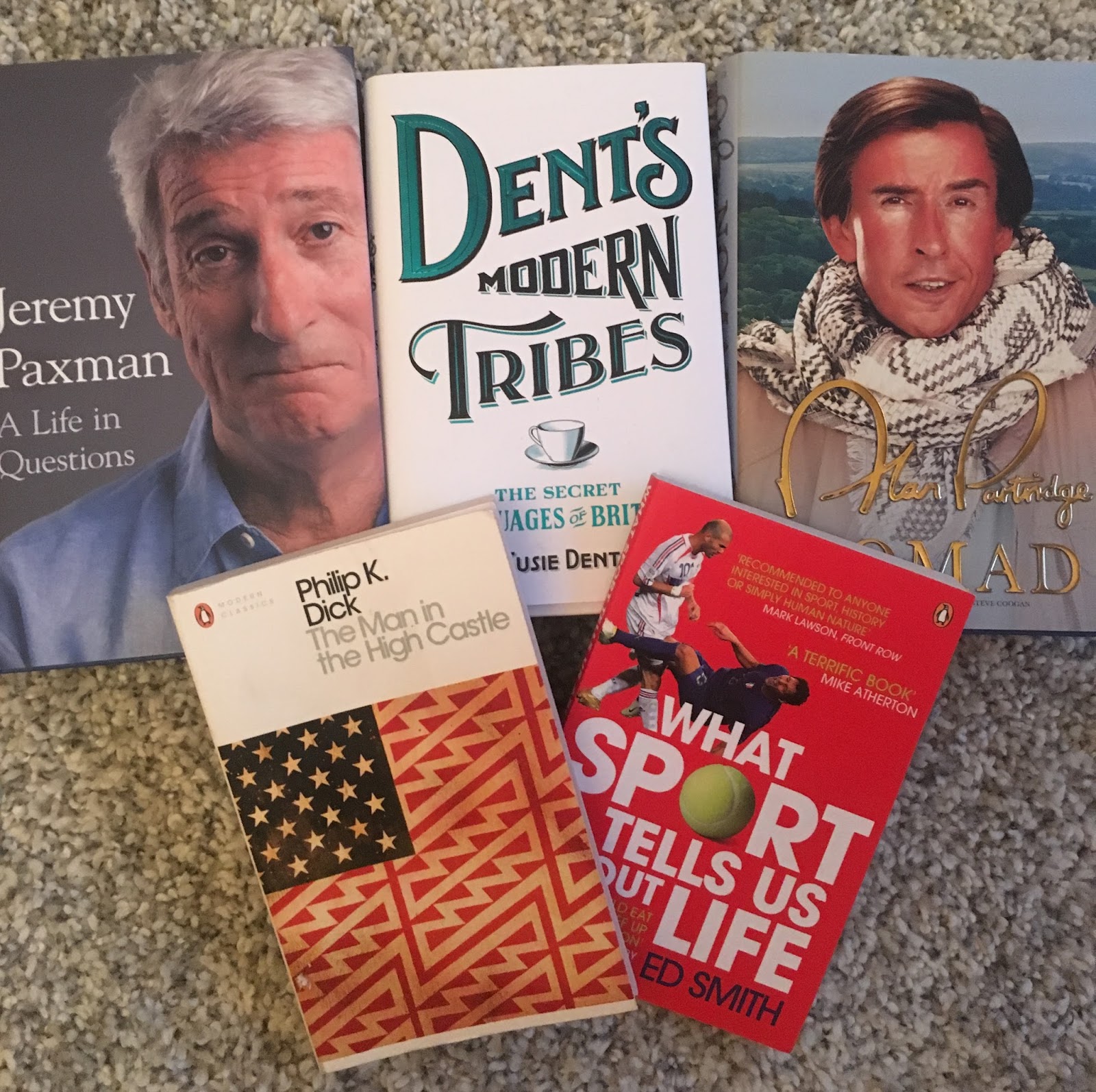
My next five books

I don't really 'do' new year resolutions, which is a good thing really because I'd be pretty late to the party with this blog. It's not just because they're naff and swiftly forgotten - although that's one big reason - but also because I have one rolling/ongoing resolution that stands regardless of what date it happens to be: to read more books.

It's something I'm continually failing to do thanks to a combination of social media (not helped by following the fortunes of a dysfunctional football club) newspapers and magazines, which all eat into valuable reading time. I've often fancied finding a sneaky retreat for 20 minutes at a lunchtime at work but always chickened out.

Still, in the spirit of getting better, I've decided to map out the next five books that I'm going to read in the hope that it spurs me on. I don't usually do this but I'm hoping that having this carrot dangled before me will do the trick. I don't profess to want to fill my time with Booker Prize winners or academic texts (although there's a few history books on the shelf that are giving me a glare), I just want to read something that captures the imagination, whether funny, entertaining or thought-provoking.

Luckily, a combination of a late November birthday and Christmas have left me in a good position, with plenty of fun things that I'm itching to get started with. If your book appears on this list, thanks very much, you obviously know me well.


Nomad, Alan Partridge

I'm an unashamed fan of Alan Partridge and have got high hopes for 'his' latest book. Following on from the autobiography - I, Partridge: We Need To Talk About Alan - Steve Coogan and Rob and Neil Gibbons have penned a spoof travel book following a not-so-epic cross-Britain journey for everyone's favourite North Norfolk Digital DJ. I think the trio have become even better at writing for Alan in recent years and their work never fails to make me smile.

The bag pages plugs alone have had me chuckling and I think this might be the perfect read to lift a gloomy January/February day and a nice one to set the ball rolling.

Dent's Modern Tribes: The Secret Languages of Britain, Susie Dent

I'm fascinated by the way in which we use language and the origins of the words we use. That's probably not very rock n roll I know, but that's me. As a result, I'm often dazzled by the insight of Countdown wordsmith-in-chief Susie Dent (she's worth a follow on Twitter too). Modern Tribes involves Dent looking at the words and terminology only used by distinct groups of people across the UK, including journalists.

A Life In Questions, Jeremy Paxman

I miss Jeremy Paxman. I mean, I know he's still on University Challenge but it's not the same. His Newsnight interviews were superb to watch and put a healthy dollop of pressure and scrutiny on public figures. If his memoirs are half as good as his interviews then they'll be a cracking read.

The Man In The Castle, Philip K Dick

I've heard plenty of good things about both this book and the Amazon Prime TV series it inspired so it's time to see what the fuss is all about. Mind you, it remains to be seen if a dystopian alternative reality in which the 'bad guys' rule America is any different to sticking the news on at the moment.

What Sport Tells Us About Life, Ed Smith

Ed Smith has become one of my favourite voices on BBC's Test Match Special, always describing the unfolding action with a beautifully relaxing and reassuring eloquence. Yet, on top of broadcasting - and a decent cricketing career - he's also a fantastically talented writer (some people eh?). So, when I stumbled upon this little beauty it was too good to miss. It's a collection of 15 essays addressing topics from 'Why there will never be another Bradman' to 'Is the free market ruining sport?' and 'What do people see when they watch sport?'. Right up my street.


So, there we go. I'm pretty pleased with how that's all looking, now it's just time to actually get on with some reading. I'll aim to come back and let you know if they're as good as I hope...

Monday, 26 December 2016

The Crown: A right royal triumph for Netflix

There's a near endless stream of hype surrounding TV these days. So much so that I find it all a bit 'cry wolf'. How can you know which series' really are the 'real deal' and which ones are just pretending to be?

It's perhaps for this reason that I've long lagged behind the modern world and resisted Netflix. I don't watch enough telly to justify getting it. Yet when we recently succumbed and signed up for the streaming service, The Crown was one of the shows on our hitlist. Much had been made of Peter Morgan' expensive royal series and the reviews had been pretty positive. Luckily, it turned out that this was one of the shows that justifies the hype. The first thing to note is the casting and the performances of the key lead roles. Claire Foy is fantastic as The Queen, embracing a role in which she carries the burden of the monarchy on her shoulders in an uncertain world.

We've probably all heard (or even attempted) enough impressions of Her Maj over the years and it'd be easy to have gone with an out-and-out impression of the long-serving monarch. Foy, however, resists this. She captures the right 'voice' and look without straying in caricature. The whole drama rests on the casting, writing and performance of this role - the fact I enjoyed it so much suggests that they got all three aspects just right.

Similar could be said for Matt Smith's Philip. I was surprised to see the former Doctor Who bag this role, but he was able to portray a subtle blend of mischief and frustration that brought the character to life.

In fact, the only role I was disappointed with was John Lithgow's Churchill. If there's one historical character we've seen impressions of more than the Queen then it's Winston and I felt this representation nudged too much toward the stereotype at times. It must've been a hard ask for a New York born actor to handle such a role. It's not awful, it's just noticeably not as good as the rest of the show.

One thing that helps all of the characters is the format of the first series. In 10 episodes, barring flashbacks, we cover the period from Elizabeth and Philip's marriage in 1947 through to the mid 1950s. While there is much ground to cover here, the length of time gives plenty of breathing space for the characters to be fleshed out. There are many dramas and films to have covered this ground before, but it's unlikely that any will have been able to do so with such depth or style.

Speaking of style, it's clear to see that the show's much-vaunted £100 million budget has been put to good use. The episodes are beautifully shot, without exception. The money hasn't gone on flashy effects, it's gone on getting all of the important things right. Looks alone should alert you to the fact that this is something special.

The substance more than matches the style, though. I was also impressed by the way in which writer Peter Morgan knitted the Queen's personal and family drama in with events in the world around her. Churchill political demise, Suez and the smog, intertwine with the abdication, Margaret's relationship and Philip's frustrations. We see how external and internal matters go on to shape the sort of monarch the Queen was to become with lessons on leadership, service and duty laced throughout all ten episodes. We also see a history of Britain through the eyes of the royal family. There's absolutely no need to be a royalist or a history buff to savour this.

None of the characters is a 2D representation of their real-world counterpart. There are things to  admire, respect and understand in most of the protagonists but we're also shown their flaws. I was perhaps only wholly sympathetic with the Queen (goodie two shoes-ness aside) and her father. Philip's petulance, Edward's money-grabbing, Churchill and Eden's politicking, the Queen Mother's scheming and, above all else, the resistance of those in the royal household to change all made for an array of actors who, for various reasons, made life complicated for the young monarch.

All in all, The Crown is a big triumph for Netflix. You feel there will be a bucket load of awards heading its way and you wouldn't begrudge that either. Roll on series two.